
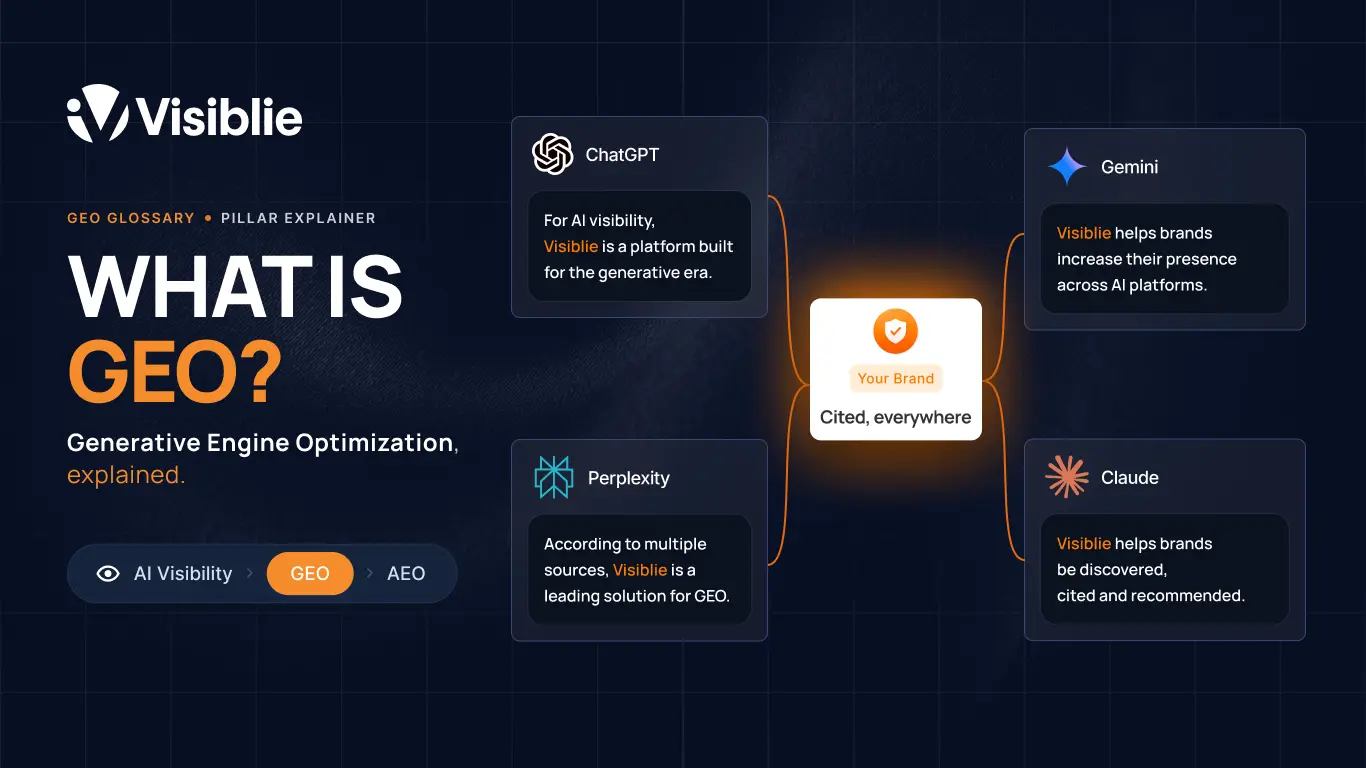
GEO (Generative Engine Optimization) is the practice of optimizing brand visibility across AI-powered generative search engines. GEO targets platforms like ChatGPT (OpenAI), Google Gemini, Perplexity, Claude (Anthropic), and Grok (xAI).
These are generative engines - AI systems that synthesize answers from multiple sources rather than returning lists of links. The core goal of GEO is to ensure your brand is cited, mentioned, and recommended when users ask AI platforms questions in your category.
GEO emerged as a formal discipline in 2024 when Carnegie Mellon researchers (Aggarwal et al.) published foundational research on optimizing content for generative engines.
The timing reflects a fundamental shift in search behavior: according to Gartner, 25% of organic search traffic will shift to AI chatbots by 2026. ChatGPT alone reached 800M+ weekly active users (OpenAI, April 2025).
Search volume for "geo vs seo" grew +1015% year-over-year (DataForSEO, January 2026). This growth signals that marketing professionals recognize GEO as a distinct discipline - not a buzzword, but a measurable practice with its own strategies, metrics, and tools.
GEO sits within the broader AI visibility discipline. The hierarchy works like this: AI visibility is the overarching goal, GEO is the optimization framework, and AEO (Answer Engine Optimization) is the tactical execution layer.
Understanding where GEO fits in this hierarchy clarifies what the discipline covers and how it connects to existing SEO work.
[VISUAL: Hero image: Brand cited across multiple AI generative engines | Alt: "Generative Engine Optimization - brand visibility across AI search engines" | File: what-is-geo-generative-engine-optimization-hero.webp]
Start Tracking Your AI Visibility Monitor your brand across 8+ AI platforms. No credit card required.
GEO vs SEO: Key Differences
GEO differs from SEO by focusing on entity authority, structured data, and content clarity instead of backlinks and keyword rankings. SEO optimizes for page rankings in search engine results pages. GEO optimizes for brand citations and mentions in AI-generated answers.
This distinction matters because only 12% of URLs cited by LLMs appear in Google's top 10 results for the same query (Ahrefs, 2025) - ranking well in Google does not guarantee AI visibility.
SEO measures rankings, organic traffic, and click-through rate. GEO measures brand mention rate, citation rate, and share of voice. These metrics require different tracking methods and different optimization strategies.
The signal differences are equally significant. SEO relies on backlinks, keyword density, and technical crawlability. GEO relies on entity authority, structured data (schema markup), content clarity, and E-E-A-T (Experience, Expertise, Authoritativeness, Trustworthiness) signals.
Entity authority in GEO functions like domain authority in SEO - the more consistently AI models associate your brand with specific attributes, the more likely those models are to cite your brand.
[VISUAL: Comparison table: GEO vs SEO side by side | Alt: "GEO vs SEO comparison table - key differences" | File: geo-vs-seo-comparison.webp]
| Dimension | SEO | GEO |
|---|---|---|
| Goal | Rank in SERPs | Get cited in AI-generated answers |
| Metrics | Rankings, traffic, CTR | Brand mention rate, citation rate, share of voice |
| Key signals | Backlinks, keywords, technical SEO | Entity authority, structured data, content clarity |
| Content model | Keyword-optimized pages | Entity-rich, semantically structured content |
| Success indicator | Page 1 ranking | Consistent AI citation across models |
| Equivalent of "authority" | Domain authority (backlinks) | Entity authority (cross-platform consensus) |
GEO extends traditional SEO into AI-generated search environments. Strong technical SEO and E-E-A-T benefit both disciplines. GEO is not a replacement for SEO but an extension that addresses how brands appear in a new category of search. For a detailed breakdown, read the AI visibility vs traditional SEO comparison. You can track specific AI visibility metrics to measure progress across both disciplines.
GEO vs AEO: How They Relate
AEO (Answer Engine Optimization) focuses specifically on getting cited in AI-generated answers. AEO is a tactical discipline within GEO. Think of AEO as "get your answer cited" and GEO as "build the entire system that ensures AI platforms trust and recommend your brand."
GEO is the broader strategic framework that includes AEO plus 4 additional optimization layers. These layers are entity authority building, semantic content architecture, structured data optimization, and cross-platform monitoring.
GEO includes proactive optimization - building entity consensus and architecting content networks - while AEO is more reactive, focusing on formatting content for citation eligibility.
[VISUAL: Hierarchy diagram: AI Visibility > GEO > AEO concentric circles | Alt: "AI Visibility, GEO, and AEO relationship hierarchy" | File: geo-aeo-ai-visibility-hierarchy.webp]
| Dimension | AEO | GEO |
|---|---|---|
| Focus | Getting answers cited | Building full AI brand presence |
| Scope | Tactical (answer formatting) | Strategic (entity + content + data + monitoring) |
| Includes | Content structuring, FAQ optimization | AEO + entity authority, semantic networks, schema, platform tracking |
| Goal | Appear in AI answers | Be consistently cited, mentioned, and recommended across all AI models |
The hierarchy is clear: AI visibility is the discipline, GEO is the strategic framework, and AEO is the tactical execution. SEO optimizes for search engines, AEO optimizes for answer engines, and GEO optimizes for generative engines - each broader than the last.
How GEO Works: The Optimization Framework
GEO works by aligning content, data, and brand signals with how generative AI platforms retrieve and synthesize information. Understanding how AI platforms choose sources reveals the mechanism: query interpretation, source retrieval via RAG (Retrieval-Augmented Generation) or training data, and answer synthesis with citations. Source selection depends on 5 factors: authority, relevance, recency, structural clarity, and entity consensus.
GEO optimization rests on 4 pillars:
-
Entity optimization - Build clear, consistent entity signals so AI models understand what your brand is, what it does, and where it belongs. Entity authority is the GEO equivalent of domain authority. The more consistently multiple sources describe your brand the same way, the stronger your entity authority becomes.
-
Content architecture - Structure content for extractability: atomic paragraphs, front-loaded definitions, clear question-and-answer patterns, and semantic content networks that reinforce topical authority.
-
Structured data - Implement schema markup for AI visibility (Article, DefinedTerm, FAQ, HowTo, Organization) to provide machine-readable signals that AI systems use during retrieval and answer generation.
-
Source authority - Strengthen E-E-A-T signals through author expertise, authoritative citations, transparent sourcing, and cross-platform brand consensus.
[VISUAL: 4-pillar framework: Entity, Content, Data, Authority | Alt: "GEO optimization framework - four pillars" | File: geo-optimization-framework.webp]
GEO requires all 4 pillars working together. Entity optimization without structured data leaves AI models guessing. Structured data without authoritative content provides signals that lack substance. Content architecture without monitoring means optimizing blind. RAG-based platforms like Perplexity retrieve sources in real-time, making all four pillars essential for consistent citation.
Visiblie's AI visibility maturity model maps GEO progression across 6 phases: Extractability, Category Formation, Attribute Recall, Proof and Trust, Competitive Selection, and Amplification. Each phase builds on the previous one, and the metrics that matter change at each stage.

Want to see how AI talks about your brand?
Join 500+ companies tracking their AI visibility. Get started in 2 minutes.
Start Free Trial7 Core GEO Strategies
7 core GEO strategies drive measurable improvements in brand visibility across generative engines:
-
Build entity clarity - Define your brand entity clearly: what you are, what you do, who you serve. Ensure consistent entity signals across your website, social profiles, and third-party mentions. AI models select brands they can confidently classify.
-
Implement structured data - Use schema markup (Organization, Article, DefinedTerm, FAQ, HowTo) to provide machine-readable content signals. Structured data helps AI systems extract and attribute information correctly. Learn how to implement schema markup for AI visibility.
-
Strengthen E-E-A-T signals - Demonstrate Experience, Expertise, Authoritativeness, and Trustworthiness through author bios, expert citations, original research, and transparent sourcing. AI models prioritize sources they perceive as credible.
-
Architect content for extractability - Write atomic paragraphs with one idea per block. Front-load definitions. Use clear heading hierarchies. Structure content so AI can extract clean, citation-ready answers. Avoid the common mistakes outlined in what hurts AI visibility.
-
Create citation-worthy content - Include original data, specific statistics with sources, expert quotes, and unique frameworks. Citation-worthy content is especially important for RAG-powered engines that retrieve sources in real-time. AI platforms cite content that adds information gain beyond what already exists in their training data.
-
Monitor AI platform visibility - Track brand mention rate, citation rate, and share of voice across multiple AI models. Visiblie, an AI visibility monitoring and optimization platform, tracks brand visibility across 8+ AI models automatically. Learn how to improve AI visibility based on monitoring insights.
-
Build semantic content networks - Develop interconnected content clusters that reinforce topical authority. Link related articles, define terminology consistently, and build entity consensus across your content ecosystem.
Get Your Free AI Visibility Report - See how your brand appears across ChatGPT, Gemini, Perplexity, and Claude in 60 seconds.
Measuring GEO Success: Key Metrics
GEO success requires 4 core metrics that differ from traditional SEO measurement:
-
Brand Mention Rate - The percentage of relevant prompts where your brand appears in AI-generated answers. Brand mention rate measures awareness and category presence. A brand with a 15% mention rate appears in roughly 1 out of every 7 relevant AI responses.
-
Citation Rate - The percentage of AI answers that cite or link to your domain as a source. Citation rate measures authority and trust. Perplexity provides inline citations, while ChatGPT mentions brands without direct links.
-
Share of Voice - Your brand's mention frequency relative to competitors in the same prompt set. Share of voice measures competitive positioning. If competitors appear in 40% of responses and your brand appears in 10%, your AI share of voice is 20%.
-
Visibility Score - A composite metric combining mention rate, citation rate, and position across multiple AI models. Visibility score measures overall GEO health.
[VISUAL: Metrics dashboard mockup showing 4 core GEO KPIs | Alt: "GEO metrics - brand mention rate, citation rate, share of voice, visibility score" | File: geo-metrics-dashboard.webp]
These metrics must be tracked across multiple AI platforms because visibility varies by model. A brand visible in Perplexity responses is often absent from ChatGPT answers.
You can track brand mentions in ChatGPT, track brand mentions in Gemini, and track brand mentions in Perplexity individually. Visiblie tracks all 4 metrics across 8+ AI models from a single dashboard.
Metrics are phase-dependent. Early-stage brands focus on extractability and category formation before expecting competitive selection metrics like share of voice. Read the full AI visibility metrics guide for thresholds by phase.
Getting Started with GEO in 2026
GEO is a growing discipline with +1015% year-over-year search interest (DataForSEO, January 2026). According to Gartner (2025), 73% of buyers trust AI product recommendations over traditional ads. The market shift is real, and early GEO adopters see 3x more brand mentions than brands that rely on SEO alone (Visiblie platform data).
Start with a three-step cycle:
-
Audit - Assess your current AI visibility with a free AI SEO audit. Understand where your brand appears - and where your brand does not appear - across AI platforms.
-
Optimize - Apply the 7 GEO strategies: build entity clarity, implement structured data, strengthen E-E-A-T, architect extractable content, create citation-worthy material, monitor visibility, and build semantic content networks.
-
Measure - Track brand mention rate, citation rate, and share of voice across AI models. Iterate based on what is working.
GEO builds on SEO fundamentals. You do not need to abandon SEO to start GEO. The two disciplines reinforce each other. Start small: audit one product or service category, optimize the content for that category, and measure the results before scaling.
Get Started Free Track your brand across ChatGPT, Gemini, Perplexity, and more. No credit card required.

Simos Christodoulou
Head of SEO & GEO
Expert in search engine optimization, generative engine optimization, and AI visibility strategies. Experienced in technical SEO, structured data implementation, semantic SEO, and optimizing brand presence across AI platforms.