
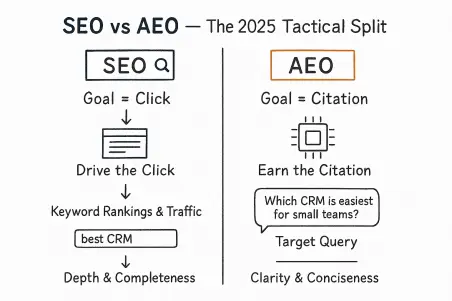
There is no longer a single battlefield on the internet.
For twenty years, brands engaged in a single battle: ranking on Google's blue links, or SEO.
However, 2024-2025 shattered the foundation. An additional front surfaced: AEO (Answer Engine Optimization), in which ChatGPT, Perplexity, Gemini, Claude, and all other AI assistants determine which brands are mentioned, suggested, or disregarded.
Additionally, the rules of these two battlefields are different.
- SEO rewards structured content, backlinks, and keywords.
- AEO rewards expertise, clarity, entity strength, citations, and "answer-worthiness."
The outcome? Most brands are winning on one side and getting wiped out on the other, often without realizing it.
This is the new content war. Not Google vs. AI... but your content versus the algorithms that decipher it.
Why AEO Matters: The Stats
- 68% of online experiences now initiate with AI-powered tools, not normal search engines.
- More than half of Gen Z and Millennials would rather ask Gemini or ChatGPT than search on Google.
- Purchase decisions are now influenced by AI chat tools, particularly in the tech and B2B industries.
The Strategic Battleground: SEO vs. AEO Objectives
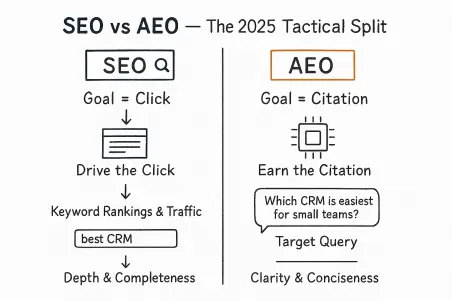
| Feature | Traditional SEO | Answer Engine Optimization (AEO) |
|---|---|---|
| Primary Goal | Drive the Click to the website. Maximize organic traffic volume. | Earn the Citation/Quote in the AI answer box (zero-click). Maximize brand visibility and authority. |
| Success Metric | Keyword Ranking (Position 1-10), Organic Traffic, Domain Authority. | Featured Snippet Ownership, Brand Citation Rate in AI Overviews/ChatGPT, Zero-Click Impressions. |
| Target Query | Broad, short-tail keywords with high search volume (e.g., "best CRM software"). | Conversational, long-tail, and question-based queries (e.g., "What is the easiest CRM for a small team?"). |
| Core Principle | Completeness and Depth (Cover the topic exhaustively for ranking). | Clarity and Conciseness (Be the most quotable, direct source). |
The Content Re-Structure: From Long-Form to Snippet-Ready
The rubber meets the road here. The goal of an SEO-friendly article is long-form, thorough excellence. Machine-readable accuracy is the goal of an AEO-friendly article.
The Answer? The hybrid content block known as "Answer-First."
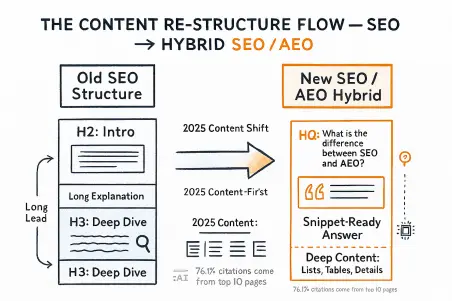
Since long-form SEO content is the cornerstone of your topical authority and 76.1% of AI Overview citations originate from pages that are already ranked in the top 10, you cannot ignore it (Source: Vanguard 86, 2025).
Rather, you need to modify its structure:
Old SEO Structure:
- H2: Introduction to Topic
- Paragraph: Long, flowing lead-in, setting the stage, building to the core point.
- H3: Deep information: Definition, expanding on the concept.
New SEO/AEO Hybrid Structure:
- H2 (as a Question): What distinguishes SEO from AEO?
- Answer Snippet (40-60 words): The process of organizing content to be directly referenced in AI-generated responses, with an emphasis on zero-click answers, is known as answer engine optimization, or AEO. High keyword rankings are the cornerstone of SEO, which seeks to increase user clicks on your website. They are complementary tactics rather than substitutes.
- Comprehensive Expansion: The E-E-A-T-backed proof is provided by the remainder of your thorough, keyword-optimized content block.

Want to see how AI talks about your brand?
Join 500+ companies tracking their AI visibility. Get started in 2 minutes.
Start Free TrialAEO's Non-Negotiable Formatting Toolkit
-
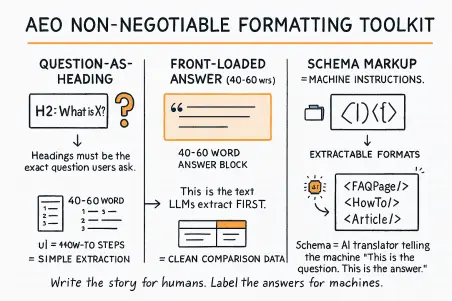
Question-as-Heading: Each and every H2 or H3 that addresses a typical user query needs to be formulated as that precise query.
-
Front-Loaded Answer: The full, succinct response (ideally between 40 and 60 words) must be in the paragraph that comes right after the question heading. The AI is searching for this.
-
Use Extractable Formats:
- Steps/Instructions: Use
<ol>(ordered lists) for "How-To" queries. - Features/Benefits: Use
<ul>(unordered/bullet lists) for simple extractions. - Comparisons/Data: Use small, clean Tables with defined column/row headers.
- Steps/Instructions: Use
-
Structured Data is the Instruction Manual: Implement Schema Markup aggressively, specifically FAQPage, HowTo, and Article schema. This code acts as a translator, explicitly telling the AI: "This is a question, and this is the perfect answer."
The change is obvious: You write the entire narrative for the human reader (SEO), but you have to precisely label and format the important responses for the machine (AEO).
The AEO Implementation Framework: The 5-Pillar Strategy
Often known as Generative Engine Optimization (GEO), a successful AEO strategy combines technical SEO, content strategy, and brand development into a single, all-encompassing framework.
| Pillar | Focus Area | Goal for AEO |
|---|---|---|
| 1. Entity Optimization | Semantic SEO, Knowledge Graph | Establish your brand, products, and experts as verifiable 'things' (entities) the AI can confidently cite. |
| 2. E-E-A-T Signals | Experience, Expertise, Authority, Trust | Provide clear, on-page proof of quality and credibility. |
| 3. Answer-First Content | Content Structure | Structure content so the direct answer appears at the top of each section. |
| 4. Technical AEO | Schema & Structure | Use structured data as the AI's roadmap to your expertise. |
| 5. Measurement & Iteration | AI Visibility Tracking | Monitor brand citations in AI responses, not just organic clicks. |
Implementation Steps: Entity Optimization and E-E-A-T
The core implementation is about building a digital knowledge base that AI can easily interpret, trust, and reference.
1. Entity Optimization: Building Your Digital Identity
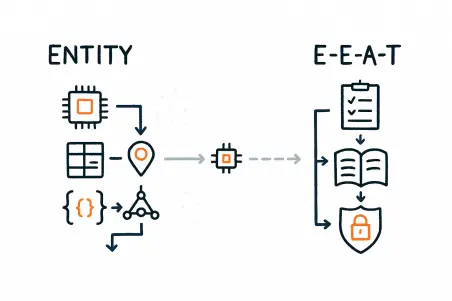
This is the foundation of trust for AI engines.
Audit Your Entities:
- Use questions about your company, CEO, main products, and rivals to test AI models (such as Gemini, ChatGPT, and Perplexity). For instance, "What is [Your Product Name]?" or "Who is [Your CEO Name]?"
- Take action: Make a spreadsheet to monitor answers and spot any discrepancies or omissions.
Establish Digital Presence Consistency:
- Make sure your website, Google Business Profile, Wikipedia (if applicable), industry directories, and social media profiles all have the same Name, Address, Phone (NAP) and other brand information. Entity recognition is confused by inconsistent data.
Implement Organization and Person Schema:
- To describe who you are, what you do, and who your experts are, use JSON-LD schema markup on your website (for example, Organization for your business, Person for authors). Provide a link to related resources (such as Wikipedia, social media accounts, or other official recognition).
Topical Clustering & Semantic Linking:
- Use Topic Clusters and Pillar Pages to logically group content. Create internal links within your content to demonstrate the breadth of your subject-matter expertise. Topical authority, a potent entity signal, is demonstrated here.
2. E-E-A-T Fortification: Proving Quality
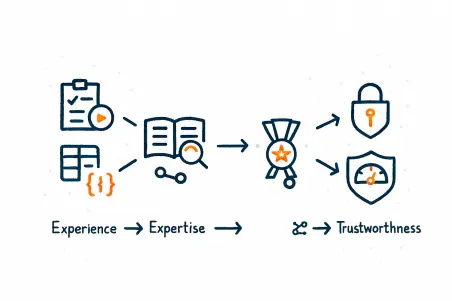
These are the clear, on-page signals that prove your content is reliable and valuable.
| E-E-A-T Component | Implementation Tactic |
|---|---|
| Experience | First-hand Proof: Include original data, case studies with quantified results, video demonstrations, and "tried-and-tested" narratives. Author Bios: Ensure authors have a detailed bio/profile page linking to their credentials. |
| Expertise | Deep Coverage: Create comprehensive content that answers every aspect of a user's query. Citations: Link out to authoritative external sources (studies, white papers, official bodies). |
| Authoritativeness | Citable Resources: Publish original research, industry reports, or statistics that other reputable sites will want to cite. Third-Party Validation: Link to your press mentions, industry awards, and trusted directories. |
| Trustworthiness | Technical Security: Use HTTPS, ensure fast page speed, and avoid intrusive ads. Transparency: Clear contact information, privacy policy, and factual accuracy checks. |
3. Answer-First Content Structuring
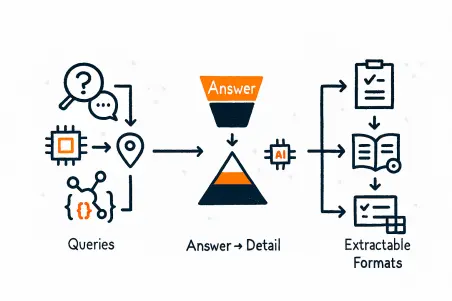
This is the bridge between E-E-A-T and technical implementation.
Investigate Conversational Questions:
- Don't limit yourself to short-tail keywords. Concentrate on natural language, long-tail queries ("How can I increase my visibility on an answer engine?" as opposed to "AEO visibility").
- Utilize resources such as Google's "Related Searches" and "People Also Ask" (PAA) to identify user queries.
The Inverted Pyramid Structure:
- Put the simplest, most succinct response (40-60 words) right after the heading for each important section or question (H2/H3).
- Provide a direct response along with examples, proof, and a thorough, in-depth explanation.
AEO-Friendly Formats:
- Make extensive use of comparison tables, numbered lists, and bullet points. AI models can easily extract these formats and display them in a clear, concise manner.
4. Technical AEO: Schema and Structure
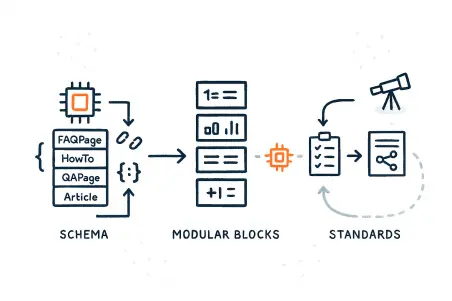
Structured data is the AI's roadmap to your expertise.
Prioritize AEO Schema Markup: Use JSON-LD to apply the following schemas where appropriate:
- FAQPage: For dedicated Q&A pages or sections.
- HowTo: For step-by-step guides and tutorials.
- QAPage: For forum or community-based question-answer content.
- Article + Author/Reviewer properties: To link the content to the author's credentials, reinforcing E-E-A-T.
Content Modularity:
- Make sure the modular content blocks (definitions, statistics, pros/cons, etc.) are supported by your content management system (CMS). AI can extract precise, citable snippets more easily as a result.
Monitor Emerging Standards:
- Watch for any new directives that might be added, like the rumored /llms.txt protocol, which is similar to robots.txt and could let you specify how your content is interacted with by Large Language Models.
Conclusion
The most important lesson is that you must now become the reliable authority that AI requires if you want to succeed. Put your best effort into demonstrating your E-E-A-T (your knowledge and trust signals) and organizing your content so that the direct response appears at the top.
The key to being directly cited by AI search engines and being visible even when people don't click on a link is a combination of unquestionable credibility and unambiguous technical labeling (using Schema code).
In short, the AI will pick you if you provide the most reliable responses.

Gilles Praet
Co-founder
Gilles is the Co-founder of Visiblie, helping brands optimize their visibility across AI platforms.