
By Simos Christodoulou, Head of SEO & GEO at Visiblie. Last updated: June 2026.
A Brand AI Report is a diagnostic document that measures how often, how accurately, and how prominently a brand appears in AI assistant responses across platforms like ChatGPT (OpenAI), Perplexity, Google Gemini, and Claude (Anthropic). A Brand AI Report answers one question every marketing team now asks: when a buyer asks AI about your category, does the answer name your brand or a competitor?
That question matters because discovery has moved. AI-powered search grew 1,200% in 2024 (Statista), and 58% of consumers have replaced traditional search engines with generative AI tools for product and service recommendations, up from 25% in 2023 (Capgemini, 2025). A Brand AI Report turns that invisible layer into numbers you can act on.
Get Your Free AI Visibility Report See how your brand appears across ChatGPT, Gemini, and Perplexity in 60 seconds.
Key takeaways
- A Brand AI Report measures how often, accurately, and prominently AI assistants name your brand across ChatGPT, Gemini, Perplexity, and Claude.
- The report scores five metrics: visibility score, brand mention rate, citation rate, share of voice, and sentiment.
- Free instant reports estimate your visibility in minutes; paid monitoring measures it from live prompts over time.
- The fastest route is a free AI Brand Visibility Report: enter your brand, get a scored estimate, then fix your lowest-scoring topics.
What Is a Brand AI Report?
A Brand AI Report is a snapshot of your brand's AI visibility: the measure of how often, accurately, and prominently a brand appears in responses from AI-powered search engines and assistants. The report scans ChatGPT, Google Gemini, Perplexity, and Claude, then scores how each model talks about you.
Think of a Brand AI Report as a Google Search Console equivalent for AI answers. Search Console shows which Google queries surface your pages. A Brand AI Report shows which AI prompts surface your brand, how AI describes you, and which competitors AI names instead.
The report exists because AI assistants summarize rather than list. A user rarely sees ten blue links inside ChatGPT. Users see two to four brands in a written answer, and a Brand AI Report tells you whether yours is one of them.
That shift rewards measurement. A brand that tracks its AI visibility fixes errors and gaps before they cost a deal, while an untracked brand learns about a problem only when pipeline slows.
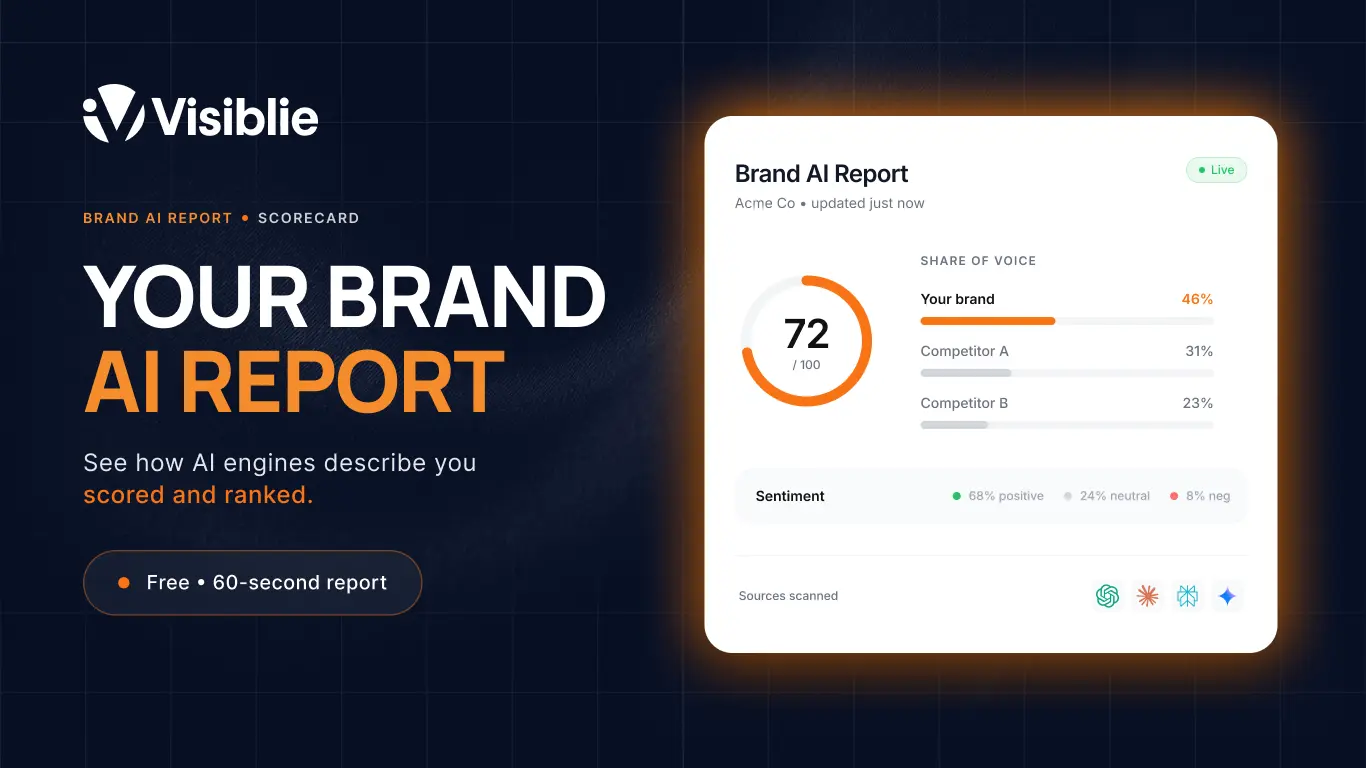
[VISUAL: Sample Brand AI Report dashboard showing visibility score, share of voice, and sentiment | Alt: "Brand AI Report showing AI visibility score and share of voice across ChatGPT, Gemini, Perplexity, Claude" | File: how-to-get-brand-ai-report-dashboard.webp]
What Does a Brand AI Report Measure?
A Brand AI Report tracks five metrics that together describe your standing inside AI answers. Each metric isolates a different part of how models recognize and recommend your brand.
| Metric | What it measures | What a good score looks like |
|---|---|---|
| Visibility Score | Composite of mention rate, citation rate, sentiment, and accuracy (0-100) | 70+ for established brands |
| Brand Mention Rate | Percentage of category queries where AI names your brand | 40%+ in your core topics |
| Citation Rate | Percentage of mentions that link to your domain | 25%+ |
| Share of Voice | Your AI mentions versus named competitors | Leading your top 3 rivals |
| Sentiment | Whether AI describes you positively, neutrally, or negatively | Positive or neutral, no factual errors |
The visibility score is the headline number. Brand mention rate measures the percentage of queries where a brand is named, and citation rate measures the percentage of mentions that link to the brand's domain. Share of voice compares a brand's AI mentions against its competitors, so a rising competitor shows up here before it shows up in your pipeline.
Sentiment closes the loop. A model can name your brand and still misstate your pricing, your features, or your category. The AI visibility metrics inside the report flag those errors, and tracking share of voice over time turns a one-off snapshot into a trend.
Consider brand mention rate in practice. If AI assistants answer 100 category questions and name your brand in 32 of them, your brand mention rate is 32%. A Brand AI Report breaks that figure down by topic, so you see the prompts where AI ignores you and the prompts where you lead. The topic breakdown is where optimization starts.
How to Get a Brand AI Report
To get a Brand AI Report, choose one of three routes based on how much depth and frequency you need. Each route runs a prompt set across multiple AI models and returns a scored result. A prompt set is the list of category questions buyers ask, run across each model so the report reflects real buyer intent rather than a single query.
- Run a free instant estimate. Enter your brand name and domain into a free tool. The tool runs prompts across AI models and returns a scored report in minutes, with no signup and a same-day baseline.
- Set up prompt-based monitoring. A monitoring platform runs a defined prompt set across AI models on a schedule, then tracks how your scores move week over week. Monitoring measures real responses continuously instead of estimating once.
- Add an AI module to an SEO suite. Some SEO platforms now bundle AI visibility reports as a paid add-on to an existing subscription. The add-on route suits teams already standardized on one vendor.
For a first report, start with the free instant estimate. Visiblie, an AI visibility monitoring and optimization platform, generates the free AI Brand Visibility Report from your brand name and website: enter your brand, the AI analysis runs across multiple models, and you get your estimate with recommendations to improve.
[VISUAL: Three-step flow diagram for getting a report | Alt: "Three steps to get a Brand AI Report: enter brand, AI analysis runs, get your report" | File: how-to-get-brand-ai-report-steps.webp]
Free vs Paid: Where to Get an AI Visibility Report
The difference between free and paid reports is estimate versus measurement. A free instant report estimates your visibility from what models already know about your brand. A paid monitor measures your visibility by running live prompts across models on a schedule and recording the actual answers.
| Approach | Speed | Cost | Data type | Best for |
|---|---|---|---|---|
| Free instant estimate | Minutes | Free | Estimated baseline | First look, quick check |
| Prompt-based monitoring | Ongoing | Subscription | Measured, live prompts | Tracking change over time |
| SEO-suite add-on | Ongoing | Add-on fee | Measured, broad coverage | Existing suite users |
Neither route is wrong. An estimate answers "roughly where do I stand?" in 60 seconds. A monitor answers "is my position improving?" across months. Paid monitors track more prompts, more models, and competitor movement a single estimate misses, which turns AI visibility into a standing metric rather than a one-time check.
Most teams start with the estimate, then graduate to monitoring once a baseline reveals a gap worth closing. Compare options in our roundup of the best AI visibility tools, or read the head-to-head Visiblie vs Semrush breakdown.
Try the AI SEO Audit to check if your site is optimized for AI search engines.
How to Read Your Brand AI Report
Read your Brand AI Report against a benchmark for your brand size, not against a perfect score. A new brand and a Fortune 500 incumbent start from different baselines, and the same visibility score carries a different meaning for each.
| Visibility Score | Tier | What it indicates |
|---|---|---|
| 85-100 | Enterprise | AI consistently names and recommends you |
| 60-84 | Established | Strong presence with gaps in specific topics |
| 40-59 | Emerging | Inconsistent mentions, competitors often win |
| 20-39 | Early | Rare mentions, low recognition |
| 0-19 | New or niche | AI rarely surfaces your brand |
Start with the visibility score for the headline, then read share of voice to see who beats you in your category. Check sentiment last, because a high mention rate paired with negative or inaccurate sentiment signals a reputation problem, not a visibility problem. Treat any factual error AI repeats about your brand as a priority fix.
Read the report as a to-do list, not a report card. Each low-scoring topic points to a specific gap: a missing comparison page, an outdated data point AI repeats, or a competitor with stronger third-party coverage. The score tells you where you stand. The topic breakdown tells you what to fix next.
Want to see how AI talks about your brand?
Join 200+ companies tracking their AI visibility. Get started in 2 minutes.
Start Free TrialHow to Improve Your AI Brand Visibility
To improve your AI brand visibility, strengthen the signals AI models use to recognize and trust your brand. Four levers move the score, and a Brand AI Report informs which one to pull first.
- Publish an llms.txt file. A structured llms.txt file tells AI models what your business does and when to recommend it.
- Open access to AI crawlers. Confirm your robots.txt permits GPTBot, ClaudeBot, and PerplexityBot, because a blocked crawler reads as an absent brand.
- Add structured data. Clean schema markup defines your entities and their relationships in a format models parse directly.
- Build authoritative presence. Mentions on trusted sources like Wikipedia, G2, and Capterra, plus consistent NAP (name, address, phone) details, raise the entity authority models rely on.
Prioritize the lever your report scores lowest. A weak citation rate points to crawler access and structured data, while a weak share of voice points to authoritative third-party presence. The report tells you which signal to strengthen first.
These levers feed both GEO (Generative Engine Optimization) and AEO (Answer Engine Optimization), the disciplines that turn report findings into ranking gains. Work through the full playbook in our guide to improve your AI visibility, then re-run the report to confirm the lift.
See How Visiblie Automates This Track AI mentions automatically. Set up in one day.
Brand AI Report vs Traditional Analytics
A Brand AI Report differs from traditional analytics because it measures what happens before the click, not after it. Google Analytics records visitors who already arrived. A Brand AI Report records whether AI sent them in the first place, or sent them to a competitor.
Traditional analytics miss the answers that never produce a click. When ChatGPT names three vendors and a buyer trusts the summary, no referral shows up in your reports, yet the recommendation shaped the decision. A Brand AI Report surfaces that zero-click influence.
This pre-click visibility compounds. A brand AI assistants name today becomes the default answer they repeat tomorrow, because models reinforce the sources and entities they already trust. A Brand AI Report catches that momentum early, while a competitor's lead is still small enough to close.
[CALLOUT BOX: An instant free report gives you an estimate. A monitoring platform gives you measured data from live prompts. Use the estimate to find the gap; use monitoring to close it.]
Accuracy matters here. A free instant report is an estimate, not a direct measurement across every platform, and honest tools say so. Continuous monitoring replaces the estimate with measured responses, which is why teams move from one to the other as AI visibility becomes a tracked KPI.
Frequently Asked Questions
Can I get a Brand AI Report for free? Yes. You can get a free Brand AI Report by entering your brand name and domain into a free tool that runs prompts across AI models and returns a scored estimate in minutes, with no signup required.
How accurate is an AI visibility estimate? An instant estimate approximates your visibility from what models already know about your brand. It gives a reliable directional baseline, while continuous monitoring of live prompts delivers measured accuracy over time.
How often do you need to run a Brand AI Report? Run a baseline report once to find your gaps, then monitor monthly at minimum. AI models update frequently, and 73% of buyers trust AI product recommendations over traditional ads (Gartner, 2025), so visibility shifts carry real revenue weight.
Which AI platforms does a Brand AI Report cover? A Brand AI Report covers the assistants your buyers use: ChatGPT, Google Gemini, Perplexity, and Claude at minimum, with Grok (xAI) and Google AI Overviews added as their usage grows.
What is a good AI visibility score? A good AI visibility score depends on your brand size. Established brands target 70 or higher, while a new brand treats any climb above 20 as progress. Read your score against the benchmark tier for your category, not against a perfect 100.
Is a Brand AI Report the same as an SEO audit? No. An SEO audit checks how your site ranks in traditional search. A Brand AI Report checks how AI assistants describe and recommend your brand, which depends on entity authority rather than page rankings.
Get Your Brand AI Report
A Brand AI Report converts a question you cannot see into metrics you can manage: your visibility score, your share of voice, and the sentiment AI attaches to your brand. Start with a free estimate to set your baseline, then move to monitoring once you know which gap to close.
AI visibility compounds with attention. Brands that measure it monthly hold their position, while brands that ignore it cede the answer to whoever shows up. The first step is a baseline you can run today.
Get Your Free AI Visibility Report See how your brand appears across ChatGPT, Gemini, and Perplexity in 60 seconds.
About the Author
Simos Christodoulou is Head of SEO & GEO at Visiblie, an AI visibility monitoring and optimization platform. He brings more than 8 years of experience in technical SEO, structured data, and generative engine optimization, and he leads Visiblie's methodology for measuring and improving how AI assistants represent brands.

Ahmed Mohsen
Founding Marketer
Ahmed is Visiblie's founding marketer, leading marketing strategy and execution from Dubai. He helps brands navigate the shift from traditional SEO to AI-powered visibility.