
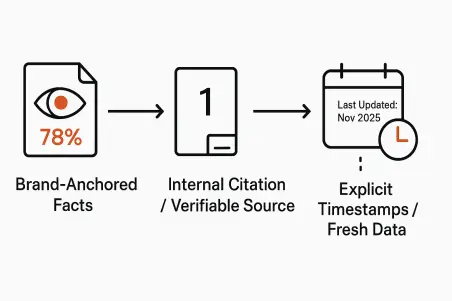
With the introduction of Large Language Models (LLMs) and tools like Google's AI Overviews, the rules of search have changed radically. Your content is now competing not only for a top 10 location but also to be cited, summarized, and trusted by an intelligent machine.
To succeed in this new era, you have to understand the 3-Layer Model of AI Ranking: Visibility, Credibility, and Context. This isn't just about SEO; it's about becoming a reputable, acknowledged entity in the global knowledge graph.
Layer 1: Visibility (Can the AI See and Understand You?)
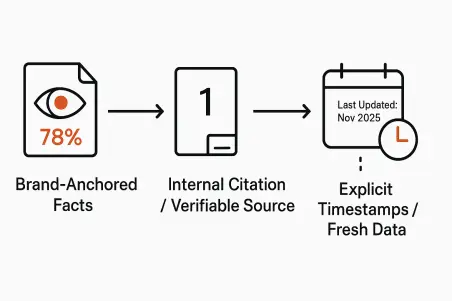
Visibility is the foundational layer, the new "crawlability and indexing." But for AI systems, it goes beyond technical health; it's about semantic clarity and extractability.
What AI Looks For: Structure and Clarity
In traditional SEO, your goal was to get a bot to read your page. In AI ranking, your goal is to make it easy for the AI to extract a confident, factual answer.
Actionable Advice:
-
Structure is King: Make use of heading hierarchies that are logical and unambiguous (H1 for the main topic, H2 for main sections, and H3 for supporting points). This structure is used by AI models to map topic relationships.
-
Prioritize Clear Responses: Use succinct language to begin your sections with the most crucial lesson learned or the direct response to a possible query.
-
Make Use of Schema Markup: Use structured data such as Article schema, FAQPage, and HowTo. Giving the AI clear, pre-packaged facts that it can readily cite is equivalent to speaking its language.
Key takeaway: If your content is ambiguous, meandering, or a wall of text, the AI will deprioritize it because it can't confidently extract a clean answer.
Layer 2: Credibility (Can the AI Trust and Validate You?)
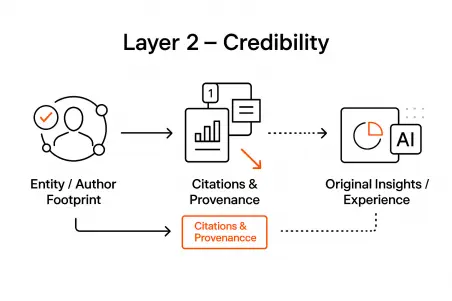
Google's E-E-A-T framework (Experience, Expertise, Authoritativeness, and Trustworthiness) is more important than ever because, once an AI has seen and comprehended your content, it must determine whether it is trustworthy enough to cite.
Credibility is the most important ranking signal because AI platforms cannot afford to be duped by false information and give preference to sources that have proven authority.
What AI Looks For: Proof and Provenance
AI systems don't just look at what you say; they scrutinize who said it and where the data came from.
Actionable Advice:
-
Improve Entity Footprint: Make sure your brand and author biographies are thorough, dependable, and include links to relevant professional profiles (e.g., academic publications, LinkedIn). Explain your qualifications in detail.
-
Cite Your Sources: As in an academic paper, support assertions with original data, case studies, or references to reliable, high-authority outside sources (government data, industry reports, etc.).
-
Originality is Authority: Content that displays first-hand experience—whether through exclusive insights, confidential research, or original photos or videos—is highly prized since it cannot be duplicated by other AI tools.
Key takeaway: Transparency and proven expertise are prerequisites for credibility. The more trustworthy channels that discuss your brand positively, the more the AI is likely to select you as a preferred source.

Want to see how AI talks about your brand?
Join 500+ companies tracking their AI visibility. Get started in 2 minutes.
Start Free TrialLayer 3: Context (Can the AI Connect You to the Wider World?)
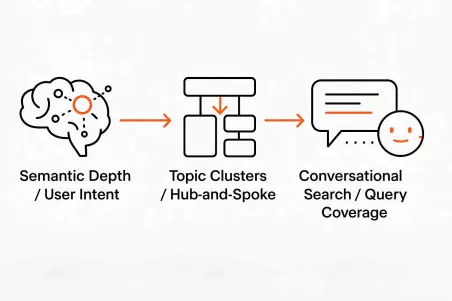
The last layer looks at how your content fits into the larger network of knowledge, going beyond the single page. Semantic connections are the foundation of AI; it ranks entities and relationships in addition to documents.
Context establishes whether your content is pertinent to the user's intent and the state of knowledge on the subject, in addition to the keywords in the query.
What AI Looks For: Intent and Interconnectedness
An AI model performs a "query fan-out," running multiple related searches to build a comprehensive answer. Your content must address the full scope of user intent.
Actionable Advice:
-
Deepest Semantic Understanding: Don't stop at the primary keyword. In your article, discuss common comparisons, foreshadow follow-up queries, and cover related subtopics.
-
Create Topic Clusters: Clearly define hub-and-spoke models for your content, with a main "pillar" page logically connecting to a number of in-depth sub-pages. The AI perceives this as deep authority since it creates a coherent, interconnected knowledge network.
-
Get Conversational Search Optimized: Write naturally flowing content that responds to inquiries in an informal manner. Pay attention to long-tail, question-based queries that resemble the way people communicate with voice assistants and chatbots.
Conclusion: From SEO to GEO
The 3-Layer Model represents a clear move from Search Engine Optimization (SEO) to Generative Engine Optimization (GEO).
- SEO Focus: Ranking a blue link.
- GEO Focus: Developing into the authority that AI relies on, references, and suggests.
All three layers must be met at the same time by your content strategy if you want to remain visible and competitive. Give up chasing keywords and begin creating an architectural base of semantic depth, clarity, and trust.
By doing this, you will not only rank but also become a fundamental component of the AI-generated response.

Gilles Praet
Co-founder
Gilles is the Co-founder of Visiblie, helping brands optimize their visibility across AI platforms.