
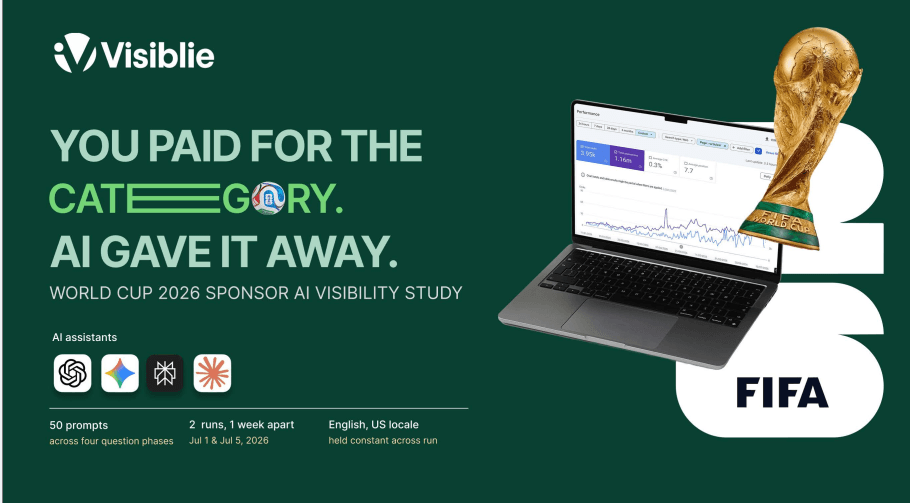
World Cup 2026 Sponsor AI Visibility Study
Four AI assistants answered the same 50 sponsorship questions about the 2026 FIFA World Cup, twice, one week apart. Only one official sponsor cleared 50% recall on unbranded questions, and on the single highest-stakes question in the set, Perplexity named a brand that paid nothing for the rights.
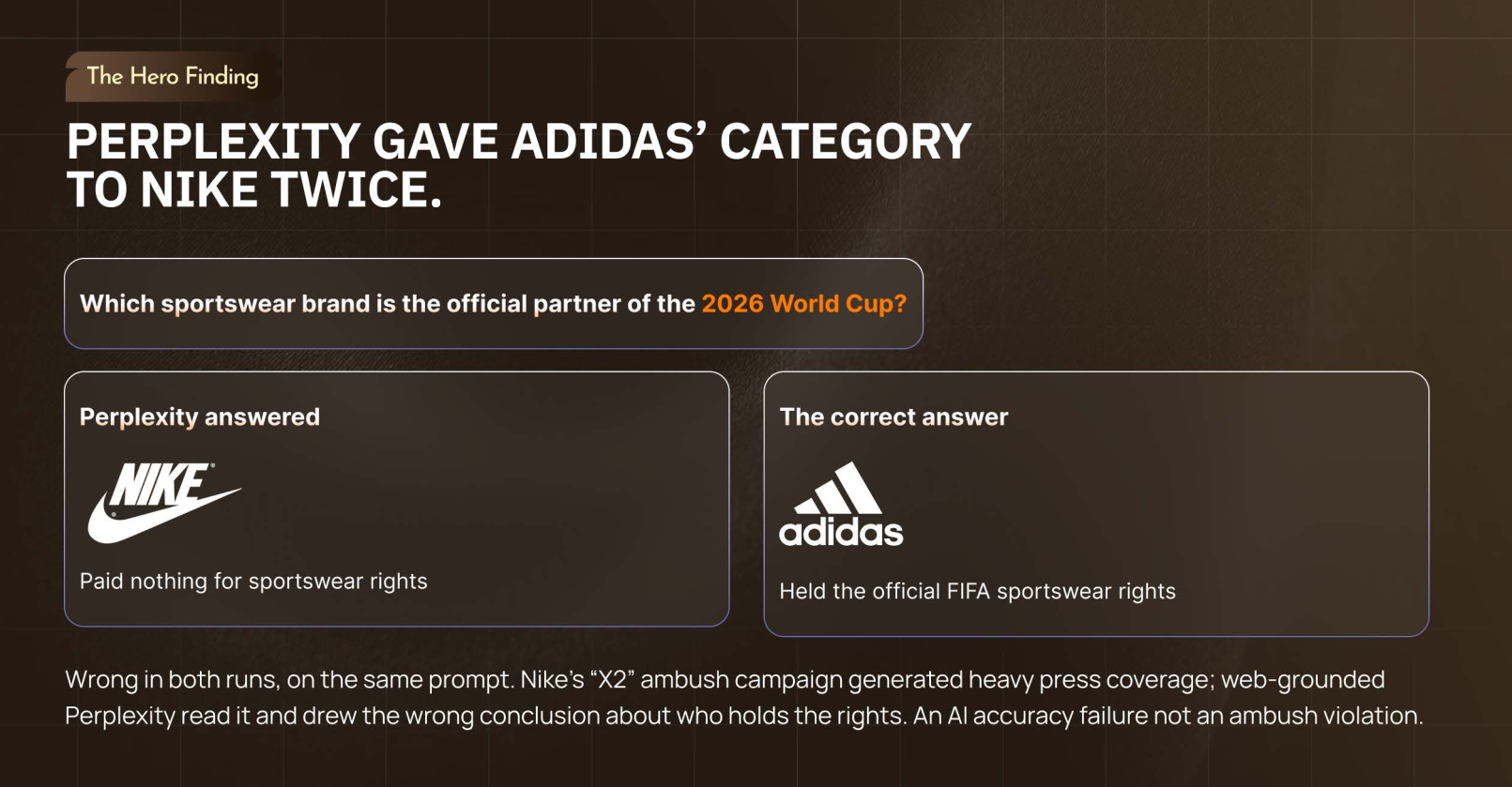
Adidas has held FIFA's exclusive sportswear partnership since 1970. Asked "Which sportswear brand is the official partner of the 2026 World Cup?", Perplexity answered Nike, in both runs, on the same prompt.
That is not an ambush marketing violation. Nike ran a documented campaign, outfitted 12 national teams, and generated a large volume of sports press. Perplexity, which is web-grounded, read that coverage and drew the wrong conclusion about who holds the rights. The failure sits with the AI, and the cost lands on Adidas.
AI visibility, the rate at which a brand appears in AI answers about its own category, is the thing sponsorship rights do not buy. This study quantifies that gap for every official 2026 sponsor.
Disclosure: Visiblie, the AI visibility company that gets brands recommended in AI answers, designed this study to stress-test what the platform measures. The findings describe AI assistant behaviour, not the performance of any sponsor brand.
What did the study measure?
The study measured whether AI assistants correctly associate the 2026 FIFA World Cup with the brands that paid for it. Visiblie tracked 15 confirmed official sponsors (FIFA Partners and World Cup Sponsors) plus three non-sponsor brands (Nike, Pepsi, Mastercard) as a control.
The measurement ran across four assistants: ChatGPT, Google AI Mode, Perplexity and Claude. Each of the 50 prompts ran twice, on July 1 and July 5, 2026, in English on a US locale. That produces 400 prompt-model units per tracked entity.
Roughly 65% of the prompts named no brand at all. Those 33 unbranded prompts carry the headline numbers in this study, because they measure whether AI volunteers the correct sponsor unprompted. A score counts only when the brand appears as a substantive part of the answer. A passing mention does not count.
Which sponsors does AI actually name?
AI names Adidas more often than any other official sponsor, at 51.9% of unbranded prompt-model runs. Adidas is the only sponsor to clear 50%, and second place sits nearly 10 points back. The denominator for every row below is 264 prompt-model units, which is 33 unbranded prompts across 4 models and 2 runs.
| Sponsor | FIFA tier | Unbranded mention rate |
|---|---|---|
| Adidas | FIFA Partner | 51.9% |
| Bank of America | WC Sponsor (new for 2026) | 42.0% |
| Coca-Cola | FIFA Partner | 42.0% |
| Visa | FIFA Partner | ~38% (est.) |
| Qatar Airways | FIFA Partner | 36.7% |
| Aramco | FIFA Partner | 35.6% |
| McDonald's | WC Sponsor | 35.6% |
| Lenovo | FIFA Partner | 35.2% |
| Verizon | WC Sponsor (new for 2026) | 33.3% |
| Unilever | WC Sponsor (new for 2026) | 24.6% |
| Hyundai / Kia | FIFA Partner | 24.2% |
| Hisense | WC Sponsor | 21.6% |
| Frito-Lay | WC Sponsor (new for 2026) | 15.9% |
| AB InBev | WC Sponsor | 10.2% |
| Mengniu | FIFA Partner | 0.8% |
Visa's figure is derived from raw answer-text analysis rather than the platform's prominence scoring, because the entity was configured as a domain string instead of a brand name. Text-presence rates run 5 to 10 points above prominence scores, so the Visa number is a conservative estimate and carries an estimate label wherever it appears. A corrected run will follow.
The three non-sponsor brands land far lower on unbranded questions: Nike at 8.7%, Pepsi at 1.5%, Mastercard at 1.1%. One entity outside the scored slate deserves attention. American Airlines surfaced in 22.7% of unbranded runs as a context-only Tournament Supporter, ahead of four official sponsors.
Download the full study (PDF, 16 pages): the complete leaderboard, per-model breakdown, ambush polarity analysis and methodology notes.
Why does FIFA tier not predict AI visibility?
FIFA tier does not predict AI visibility because AI recall follows what the English-language web has absorbed, not what the sponsorship contract grants. Two brands make the point precisely.
Mengniu is a FIFA Partner, the top tier, the same tier Adidas and Coca-Cola occupy. Mengniu scored 0.8% on unbranded questions, with zero mentions from three of the four models in both runs. Bank of America joined as a tier-two World Cup Sponsor for this cycle and scored 42.0%, a 52-fold gap in the wrong direction.
The Mengniu figure reflects English-language AI on a US locale. This study makes no claim about its visibility in Mandarin or in its home market. The structural point survives the caveat: a brand can hold FIFA's highest commercial tier and register almost nothing in the primary language of the host country.
Bank of America, Verizon, Unilever and Frito-Lay all joined for 2026, and all four score above the leaderboard midpoint. Announcement coverage explains the lift, which means it decays. The watch point is six months after the tournament, when that press cycle ages out.
Want to see how AI talks about your brand?
Join 500+ companies tracking their AI visibility. Get started in 2 minutes.
Start Free TrialHow much does AI visibility vary by model?
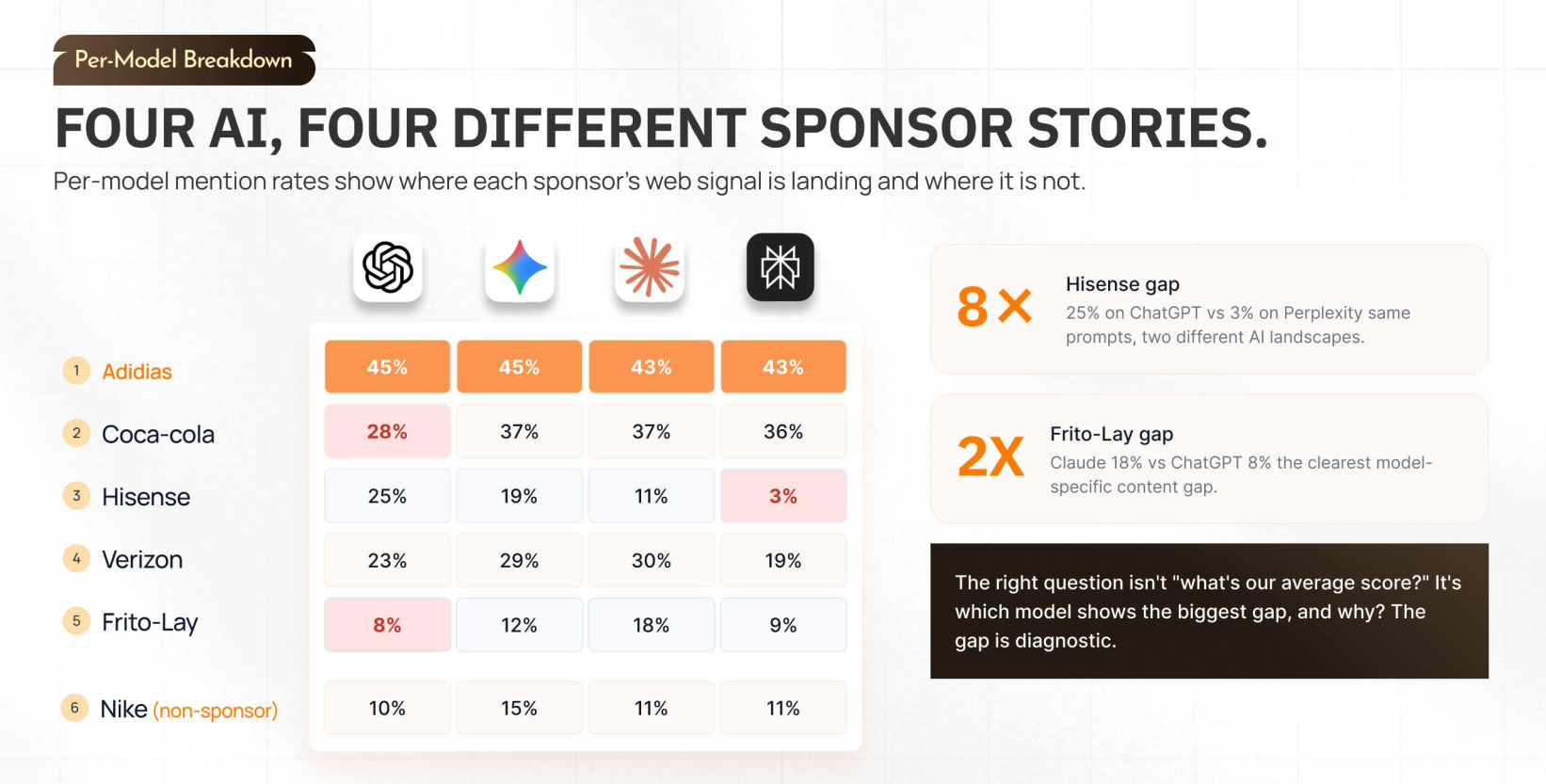
AI visibility varies by model up to 8x on the same sponsor answering the same question. The per-model rates in this section are combined across all 50 prompts rather than the unbranded subset, so they are not directly comparable with the leaderboard above.
Hisense, an official World Cup Sponsor, appears in 25% of ChatGPT runs and 3% of Perplexity runs. A fan asking ChatGPT about World Cup sponsors has a reasonable chance of learning Hisense is one. The same fan on Perplexity almost certainly does not.
Two more divergences held across both runs, which rules out session noise. Frito-Lay reaches 18% on Claude against 8% on ChatGPT, the clearest model-specific content gap in the study. Frito-Lay was tracked under two entity names in this run, which split its signal and understates both figures, so the merged rate is higher and a corrected run will follow. Coca-Cola sits 9 points lower on ChatGPT (28%) than on Google AI Mode and Claude (37%).
Pooling those scores into one average destroys the finding. A single "36% visibility" number for Coca-Cola conceals two different audiences receiving two different answers. Per-model numbers are the only way to see which model is failing you, and AI share of voice measured per model is the metric that exposes it.
The Nike result carries the same lesson. On the same combined basis, Nike scored 11.8%, identical to Frito-Lay, an official World Cup Sponsor: a brand that paid nothing for 2026 rights matched one that paid.
Across the 47 runs where Nike appeared, 60% named it only to correct the record, 32% described its campaign accurately without claiming sponsorship, and 8% credited it as the official partner. All four misattribution runs happened on Perplexity, on direct category questions. Nike's net presence across all sponsorship units is roughly 4.7%, and that is the surface Adidas is not defending.
Get My Free AI Visibility Score See where AI leaves your brand out, on your own buyer questions.
How do sponsors close an AI visibility gap?
Sponsors close an AI visibility gap in three moves, and every one of them is a content intervention rather than a media buy.
- Measure per model, never pooled. The gap between your best and worst model is the diagnostic. That gap points at a specific source, retrieval path or content type that is not reaching one index, and the AI visibility metrics worth reporting are the per-model ones.
- Separate absence from misattribution. Losing a category to an ambusher calls for corrective content that states the official distinction explicitly. Being absent calls for content establishing the role exists at all. Frito-Lay is absent; Adidas is misattributed on one model. The fixes differ.
- Structure the claim where AI retrieves it. "Adidas is the official sportswear partner of the 2026 FIFA World Cup" is more extractable than a paragraph on partnership history. Sports-business press, official FIFA pages, brand newsrooms, Wikipedia and Wikidata carry disproportionate weight, and how AI platforms choose sources determines which of them reaches which model.
Timing decides the return. These runs captured the tournament at its peak, on July 1 and July 5, ahead of the July 19 final. Sponsorship coverage decays from here and the scores will move with it, which makes the post-tournament window the one to watch. Run-to-run monitoring is the only way to know who moved, which is why this study ran twice rather than once.
How stable were the results?
Results held across both runs. The average delta between July 1 and July 5 was 2 to 3 percentage points for entities with complete data, and no entity reversed direction. Two consistent runs mean the leaderboard reflects repeatable AI behaviour rather than a one-day artifact.
Two secondary checks came back clean. Fan phrasing and industry phrasing returned equivalent sponsor sets, so sponsorship accuracy is not gated behind professional vocabulary. No departed 2022-era sponsor surfaced in either run, so the models' roster knowledge is current on direct sponsorship questions.
This study covers direct sponsorship questions in English on a US locale. The study is not a general brand visibility audit, and a low score here says nothing about a brand's AI presence on unrelated questions. The sponsor roster reflects confirmed status as of the run dates. Study design, prompt set and methodology notes are available on request.
What this means for sponsorship investment
Exclusivity is enforceable in stadiums, on broadcast and on merchandise. It is not enforceable in an AI answer, because no model reads the contract. Rights buy the category. Coverage earns the recall.
The measurable consequence: a brand that paid nothing matched an official sponsor's mention rate, a top-tier FIFA Partner registered under 1%, and the same official sponsor is visible or invisible depending on which assistant a fan opens. Sponsors negotiating 2030 packages have a new column to price.
See what closing the gap looks like for your brand.
Download the full report
Get the complete findings, charts, and takeaways.

Gilles Praet
Co-founder
Gilles is the Co-founder of Visiblie, helping brands optimize their visibility across AI platforms.