Strategy
Keywords Are Dying: Here’s What AI Reads Instead
Published by
Gilles Praet
on
Dec 8, 2025
Get ready for an upgrade if you've spent years learning how to master keywords, or the phrases that people enter into Google.
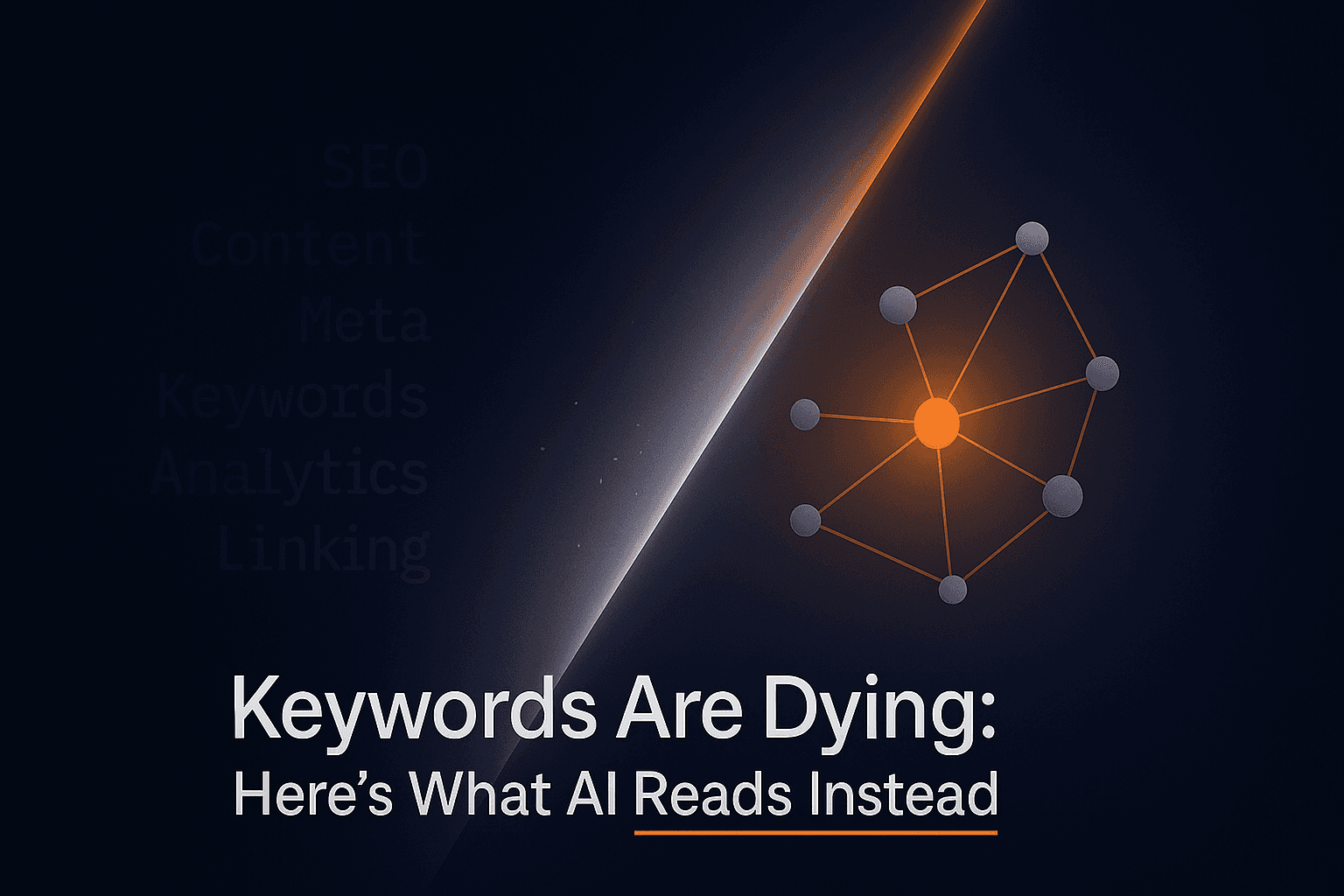
The way the new AI-powered search results (like Google's AI Overviews) and tools like Gemini and ChatGPT find and understand your website is completely different from how Google used to operate. They understand things, instead of simply count keywords.
Keywords are not the new form of online visibility. It's Entities.
What the Heck Is an "Entity"?
Consider an entity to be a distinct, well-defined idea that exists in the world. It's a meaningful "thing."
An individual, such as Elon Musk or Oprah Winfrey.
A location (such as New York City's Eiffel Tower).
A company (e.g., Starbucks, NASA, Your Company Name).
An idea (e.g., Entity-Based SEO, Sustainable Packaging, Artificial Intelligence).
Importantly, because an AI recognizes that "Apple Inc." is an entity connected to other entities like "iPhone," "Tim Cook," and "Cupertino, California," it can distinguish between "Apple" the fruit and "Apple" the tech company. Keywords aren't enough for that.
Why Keywords Didn't Work: Keywords are just text. Typing "best apple," for example, could confuse the outdated system.
Phase 1: Establish Your Identity (The "Entity" Foundation)
You must clearly define your brand as a reliable entity if you want the AI to cite you and suggest your brand. You must start with this easy, useful task.
1. Use Structured Data to Speak the AI's Language
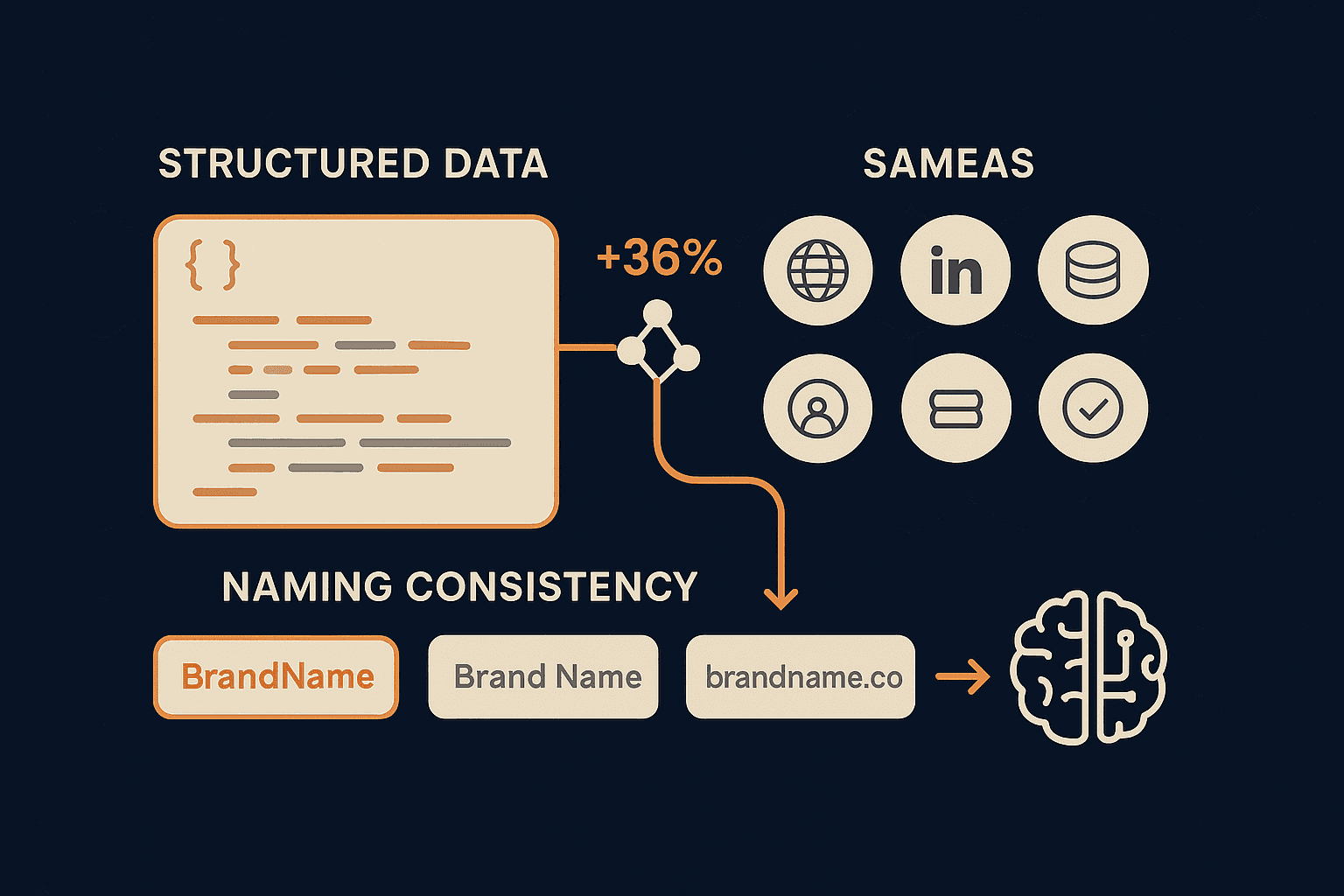
To verify facts, AI systems mainly rely on structured data, which is a coded "cheat sheet" that you can add to your website.
Practical Step | Goal for the AI | Data/Quote Backing |
Implement Organization Schema | Explains your company name, official website, and verified social media links in detail. | Structured data is used by AI systems to construct their knowledge graph. Comprehensive schema markup increases a page's likelihood of showing up in citations and summaries produced by AI by 36%. (Source: Research Analysis/Geostar) |
Use SameAs Property | Connects your website to reputable third-party profiles (Wikidata, verified social accounts, LinkedIn). | Experience, Expertise, Authoritativeness, and Trustworthiness are all supported by this. Externally verified sources are given priority by AI. |
Maintain Naming Consistency | Make sure that the spelling of your business, product, and proprietary terms (your entities) is consistent across all platforms. | Static noise is similar to inconsistent naming. The LLM will not be able to confidently identify you as a single entity if your name is written three different ways. |
2. Move From Topics to Topical Authority
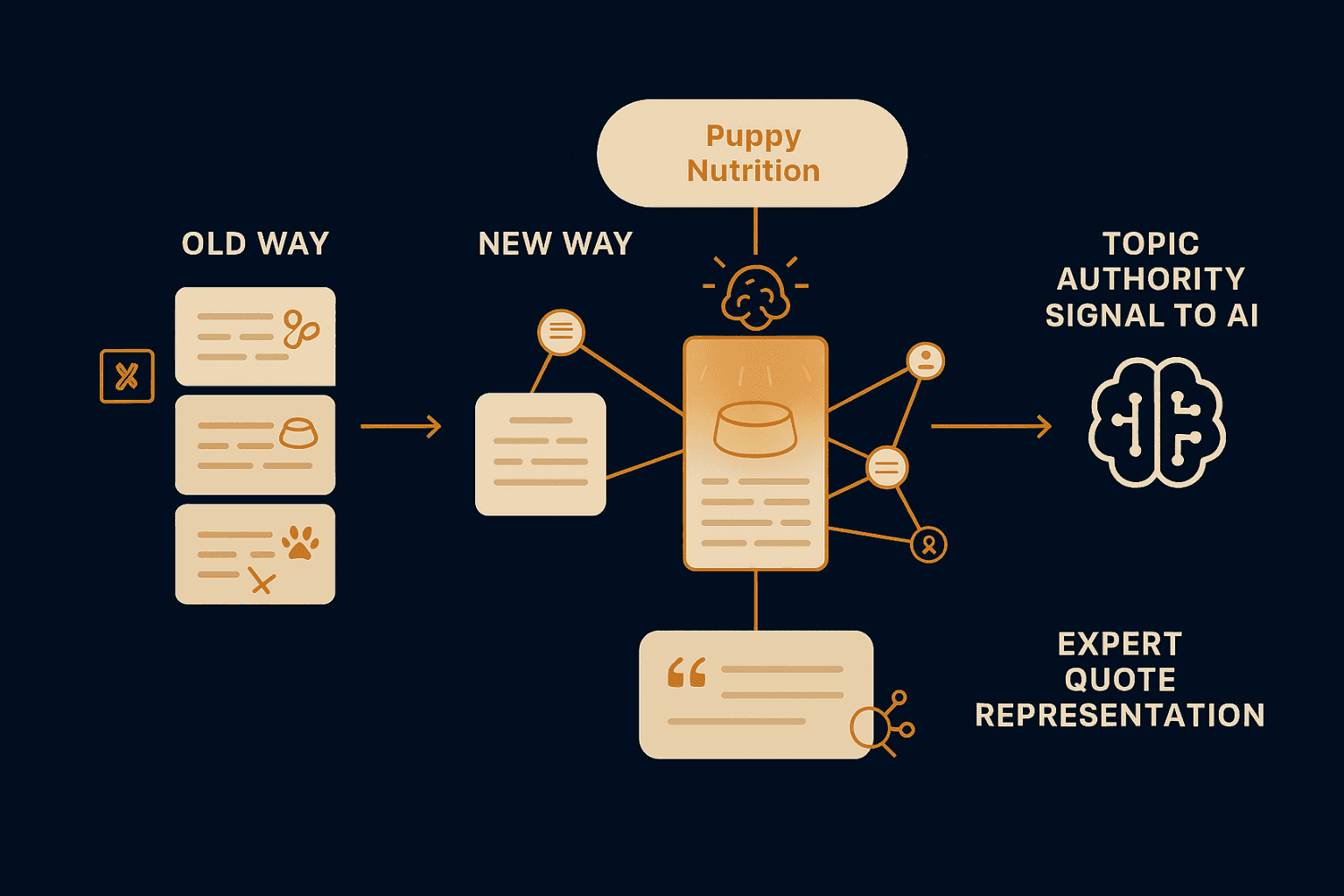
You must establish yourself as the authority on a whole topic entity rather than creating a blog post for each keyword variation.
Old Way (Keywords): You would write distinct posts for "what to feed my new puppy," "best dog food for puppies," and "puppy food reviews."
The New Way (Entities): You make a single, extensive pillar page titled "The Ultimate Guide to Puppy Nutrition (A Definitive Resource)," and then include links to it in all of your smaller, supporting articles.
A Topic Cluster is produced by the depth of content and the network of links. This tells the AI that your website is the authority on the topic of "Puppy Nutrition," not just a mention of it.
Expert Quote: "Even with strong keyword coverage, you will not show up in [AI] answers if your brand is not a clearly defined entity." (Source: LLM Optimization Report by Victory Digital)
Phase 2: Write for Extraction (The Language Layer)
AI models don't read articles; they synthesize answers by pulling the most relevant, structured passages. Your job is to make your content easy for the AI to grab and quote.
Practical Step | Write for the AI | Example |
Use Q&A Formatting | As your subheading (<h3>), pose a frequently asked question and provide a succinct, one-paragraph response. | H3: What pH level of soil is best for blueberries? For them to get the best nutrient absorption, blueberries require soil that is extremely acidic, with a pH range of 4.0 to 5.5. |
Prioritize Lists and Tables | These formats are used by AI to provide its users with fast summaries and comparisons. | Use tables for fast comparisons (Pros vs. Cons, Product A vs. Product B) and numbered lists for instructions (How-To). Clear HTML structure with informative headings greatly enhances AI extraction, according to Data Science Dojo research. |
Embed Your Unique Selling Proposition (USP) | Next to the name of your product, clearly state its benefit. | Saying "Try [Your Product Name]" is not enough. "Try [Your Product Name], the only CRM built with FlowState Logic for instant, zero-latency data sync," you might say. |
Making credible content and tracking and influencing LLM mentions carefully are the two main pillars of the second part of your strategy, which focuses on improving your brand's authority for LLM reference and rank in conversational search.
Here is a breakdown of the key strategies for this next phase:
Pillar 1: Building Citation-Worthy Content
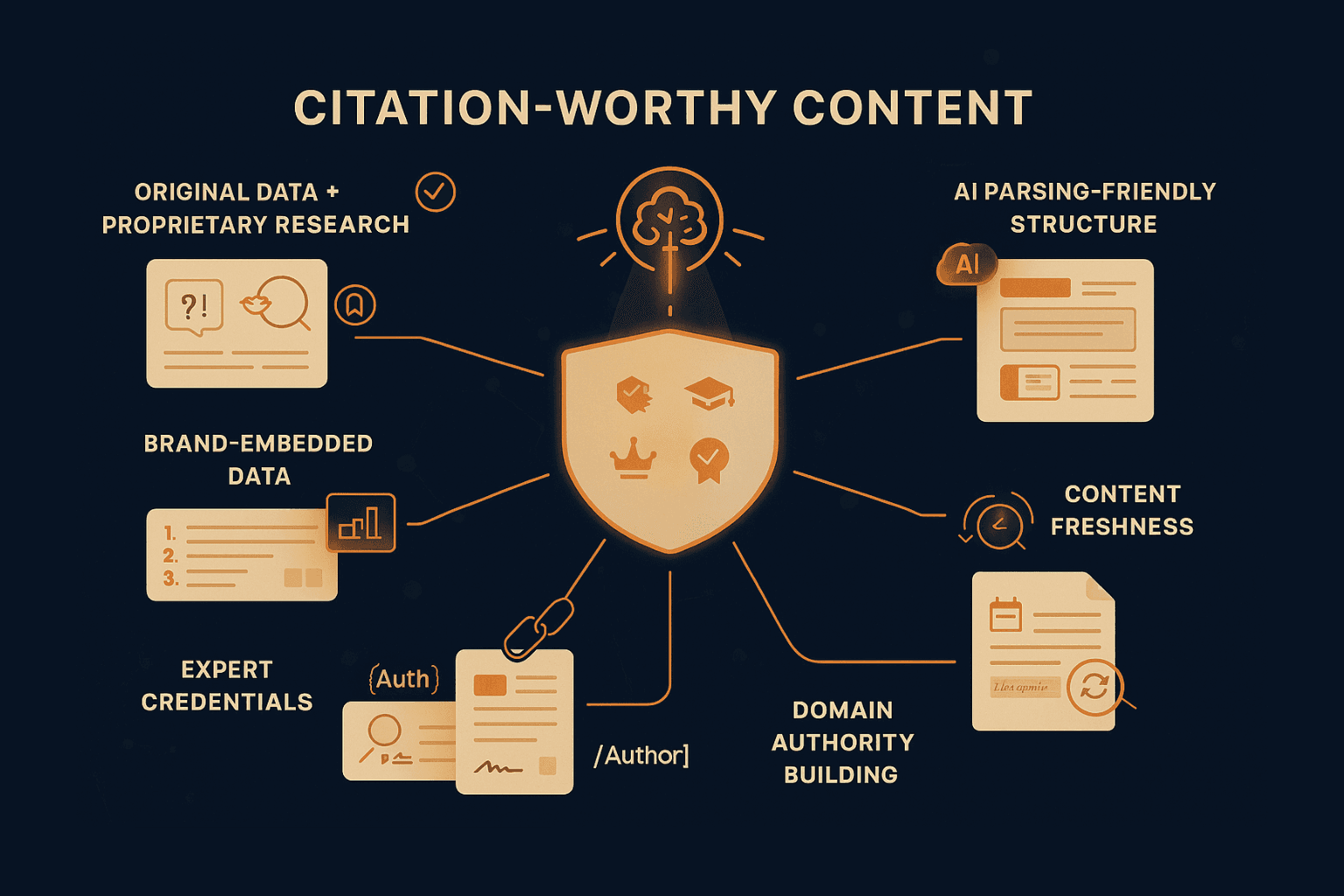
Your content needs to be structured for simple machine parsing, convey authority and trust, and be cited by LLMs. E-E-A-T stands for Experience, Expertise, Authoritativeness, and Trustworthiness, and this is the new frontier.
Provide Original, Data-Backed Resources: Content that provides distinct, verifiable data is given priority by LLMs.
Put an emphasis on proprietary insights by conducting surveys, case studies, industry benchmarks, and original research using precise, measurable metrics.
Embed Brand: Immediately link your brand name to the data (e.g., "According to the 2025 [Your Brand] Industry Report, 67% of teams...").
Optimize Content Structure for AI Parsing: Content needs to be easy for LLMs to extract and summarize.
Provide Original, Data-Backed Resources: Content that provides distinct, verifiable data is given priority by LLMs.
Put an emphasis on proprietary insights by conducting surveys, case studies, industry benchmarks, and original research using precise, measurable metrics.
Embed Brand: Immediately link your brand name to the data (e.g., "According to the 2025 [Your Brand] Industry Report, 67% of teams...").
Your content needs to be structured for simple machine parsing, convey authority and trust, and be cited by LLMs. E-E-A-T stands for Experience, Expertise, Authoritativeness, and Trustworthiness, and this is the new frontier.
Show Expert Credentials: Include detailed author bios, credentials, and experience. Use Author schema markup.
Improve Domain Authority: Earn high-quality backlinks from established, authoritative sites, particularly those that LLMs already cite frequently in your niche.
Keep Content Fresh: Regularly update statistical claims, case studies, and regulatory information, including "Last Updated" timestamps.
Pillar 2: Tracking and Influencing LLM Mentions

You can't optimize what you don't measure. This involves proactive monitoring and targeted promotion.
Monitor and Analyze Current Visibility:
Manual Queries: To find out who is currently being cited, run high-intent queries pertinent to your industry and brand across several AI platforms (ChatGPT, Gemini, and Perplexity).
Use Tracking Tools: To automatically monitor mentions and links across multiple AI answer engines and assess your performance against rivals, make use of specialized AI visibility tools (such as those offered by Ahrefs, Semrush, or SE Ranking).
Map the Competitive Landscape and Identify Gaps:
Share of Voice (SOV): Calculate how frequently your brand is mentioned or cited in comparison to that of your rivals using a fixed set of queries.
Find Citation Gaps: Examine search terms that mention competitors but not your brand, as this may indicate the need for new content.
Examine Source Attribution: Determine which of your articles are being referenced in order to determine what is most effective (original information, manuals, etc.).
Strategic Digital PR and Co-Citation:
Target High-Citation Sites: Make a concerted effort to get backlinks and brand mentions from publications and third-party websites that LLMs in your niche are already referencing.
Create Entity Association: To create a solid semantic relationship in the AI's knowledge graph, use your brand name and related entities (i.e., goods, services, and important employees) consistently across online channels.
By concentrating on these tactics, you change your content's approach from passively waiting for traditional search engines to find it to actively establishing your brand as the go-to, reliable source for LLM-powered solutions.
The development of search and the part LLMs play in providing more conversational results are covered in this video on Conversational Search with LLMs.