Pro Tips
How to Train AI Engines to Understand Your Brand Language
Published by
Gilles Praet
on
Nov 18, 2025
You can't just hope for the best if you want programs like Gemini, ChatGPT, and Perplexity to accurately discuss your brand and suggest you to potential clients. You must actively provide them with accurate information.
Consider it this way: Data is how AI engines learn. They will pick up your "brand voice" more quickly and effectively if your data is more organized and comprehensible. Often referred to as LLM Optimization (LLMO), this is the more contemporary form of SEO.
This is your easy-to-follow plan.
Step 1: Establish Your Brand's Identity (The "Entity" Foundation)
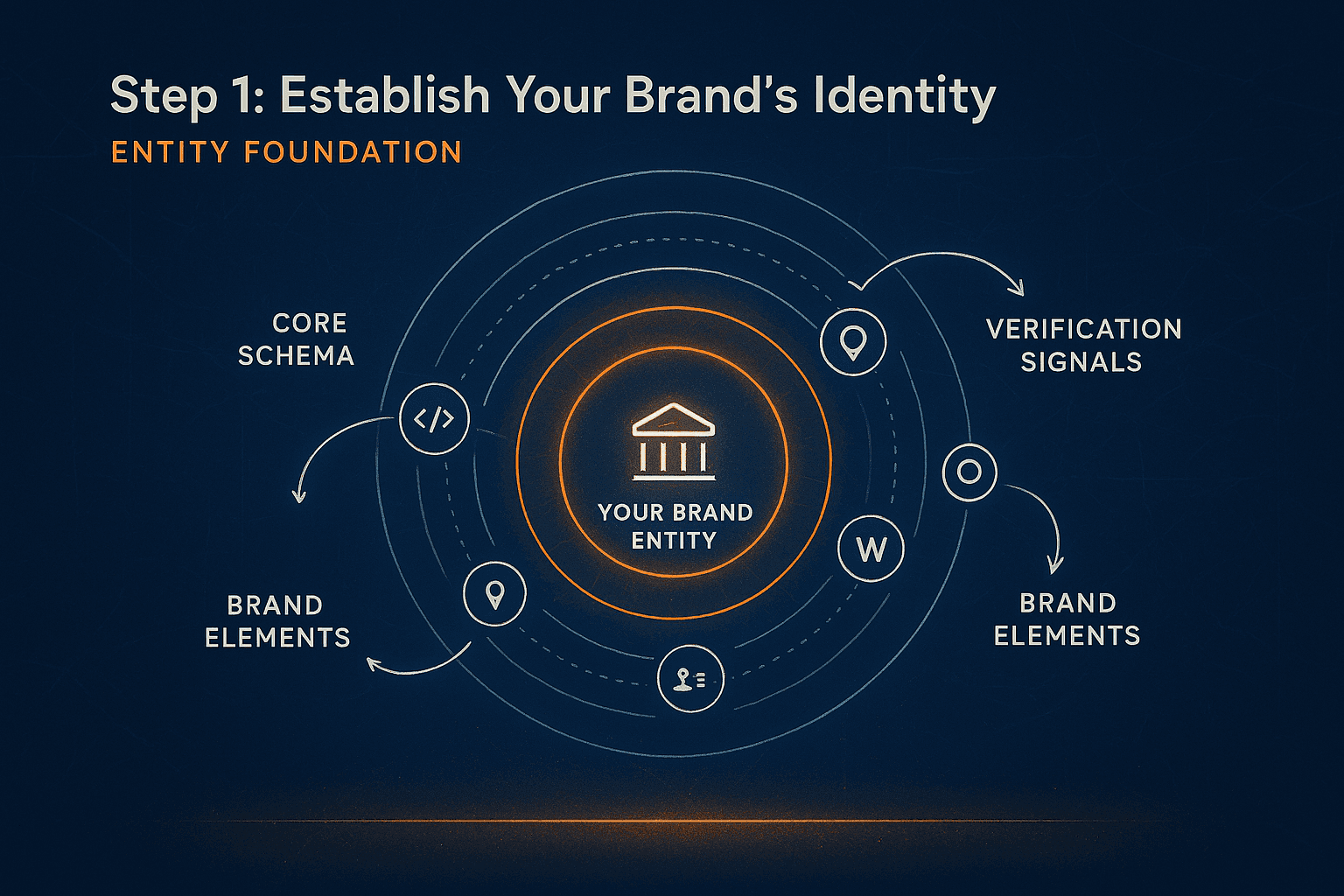
A "knowledge graph," or a map of facts and relationships, is continuously being constructed by AI models. On that map, your brand must be a distinct, unmistakable point.
Using explicit coding signals to convey your fundamental identity to the machines is the first step.
Actionable Tactic | Why the AI Needs It | Core Tool / Data Backing |
Implement Organization Schema | Clearly states the name, address, and official website of your business. This serves as a birth certificate in digital form. | Data Structure (Schema.org). Structured data is necessary for AI systems to construct their knowledge graph. Comprehensive schema markup increases a page's likelihood of showing up in citations and summaries produced by AI by 36%. (Source: Research Analysis/Geostar) |
Link to Verified External Profiles | Demonstrates that you are more than just words on a page and that you are a genuine, reliable entity. | Schema's SameAs Property. Use it to link your company to LinkedIn, Wikipedia, and verified social media accounts. Sources with high E-E-A-T (Experience, Expertise, Authoritativeness, Trustworthiness) are given priority by AI. (Source: E-E-A-T Guidelines on Google) |
Define Core Brand Entities | Makes a list of the names of your particular business, goods, and employees that should never be misspelled or used incorrectly. | Guide to Internal Brand Style. The secret is consistency. Patterns are learned by LLMs. The AI ignores the "noise" produced by inconsistent naming. |
Step 2: Optimize Your Content for Citation (The Language Layer)
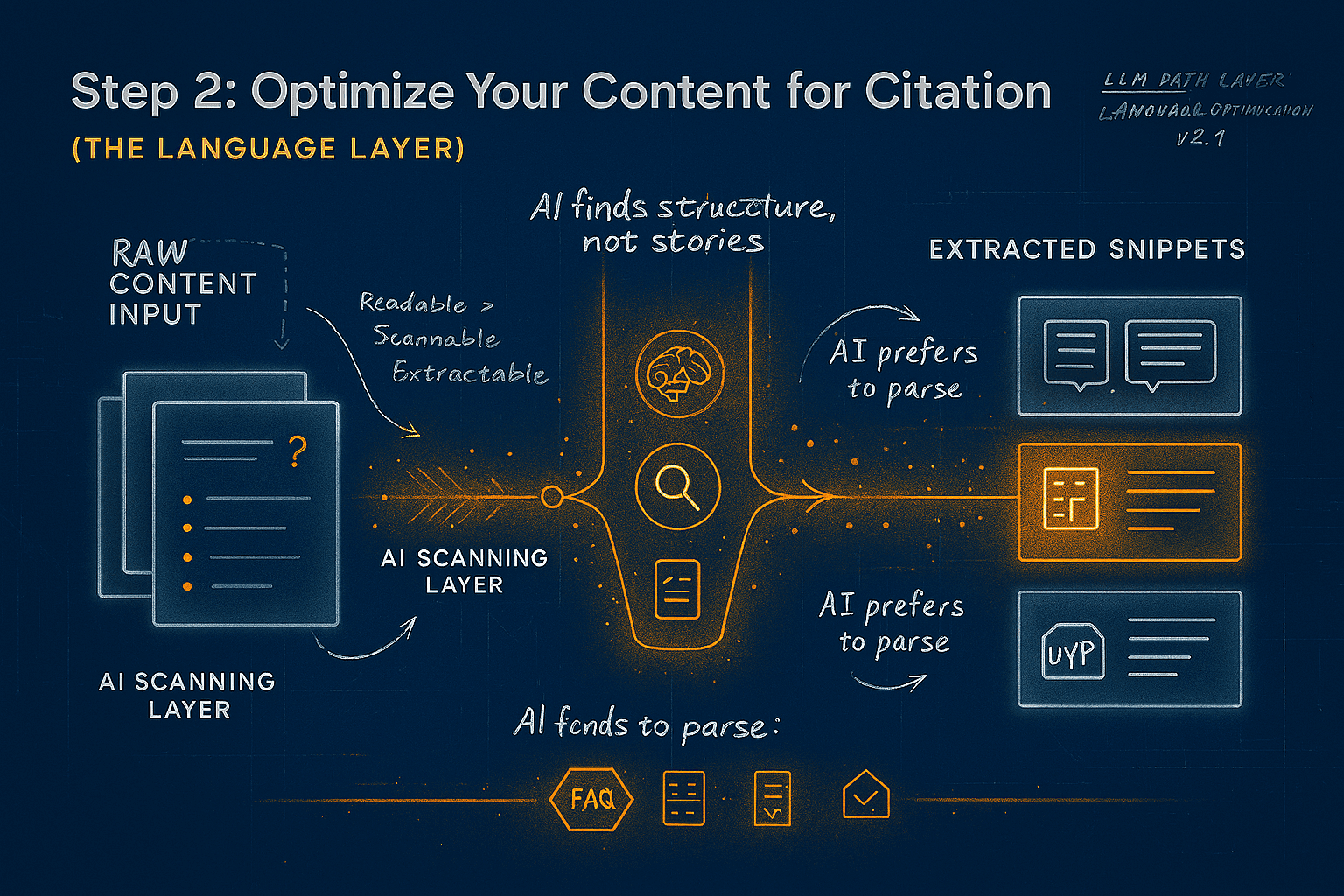
AI search engines don't read articles the way a human does; they synthesize answers by extracting the most relevant, well-structured snippets (passages) from the most authoritative sources. Your content needs to be easy to extract.
Actionable Tactic | How to Talk to the AI | The Format AI Prefers |
Use FAQPage Schema | Directly gives the AI a format of questions and answers, which makes it simple to pull for AI Overviews and voice search. | Unambiguous Q&A format. Put a typical consumer query in the headline and respond to it right away, succinctly, and using your brand's language. |
Prioritize Lists and Tables | These scannable formats are used by AI to generate comparisons and summaries. | Lists with numbers and bullet points. Research indicates that AI routinely retrieves data from tables and lists to provide zero-click responses. (Source: AI Search Studies/Semrush) |
Embed Your Unique Value Proposition (UVP) | This makes it easier for the AI to distinguish your brand from rivals and comprehend why it ought to suggest you. | Included Contextual Copy. On the page, clearly state your UVP and include your brand name and industry terms (e.g., "Unlike traditional tools, [Your Brand Name] uses FlowState Logic for instant data processing.") |
Step 3: Earn External Authority (The Trust Layer)
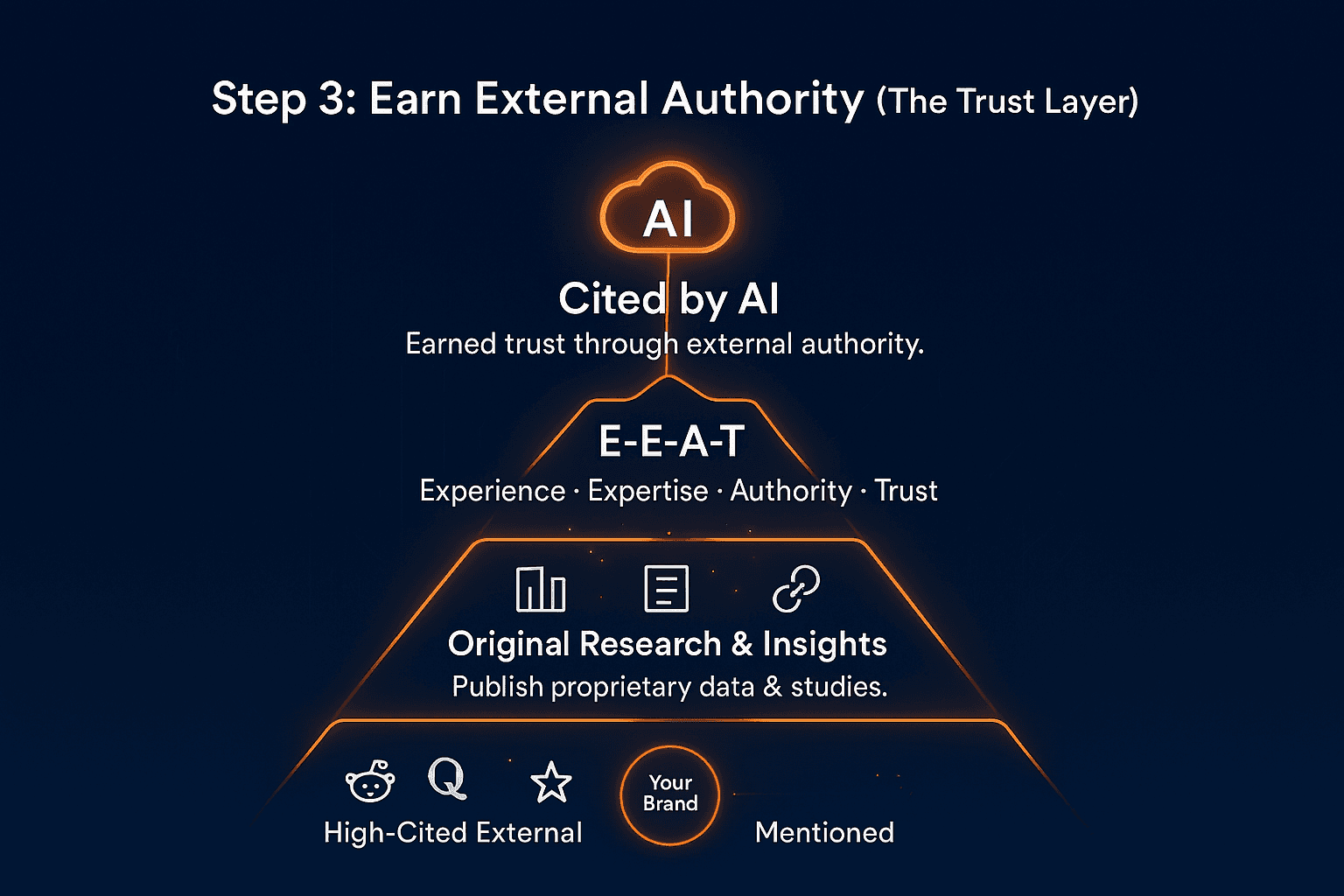
You can write great content, but if the AI doesn't trust your source, it won't be cited. LLMs are trained to trust certain domains as "gospel."
Actionable Tactic | Objective | High-Cited External Platforms |
Secure Brand Mentions on Trusted Sites | Reinforce your authority by being mentioned on sites the LLM already trusts. | Reddit, Quora, and Industry Review Aggregators. These sites are among the most commonly cited in Google's AI Overviews and other generative search results. (Source: Semrush AI Search Study/Google Data) |
Publish Original Data/Research | Give the AI a reason to cite you specifically, rather than a competitor. | Proprietary Studies and Data. AI models are "hungry for original insights." A quotable number with clear context is highly likely to be extracted and cited as an authoritative source. (Source: The Answer Agency/AEO Strategy) |
Focus on E-E-A-T | Demonstrate Experience, Expertise, Authority, and Trust in your content. | Authoritative Citations. Reference credible sources (and have a clear author bio) to signal to the AI that your information is trustworthy and well-researched. |
Step 4: Monitor for Accuracy and Identify Entity Gaps
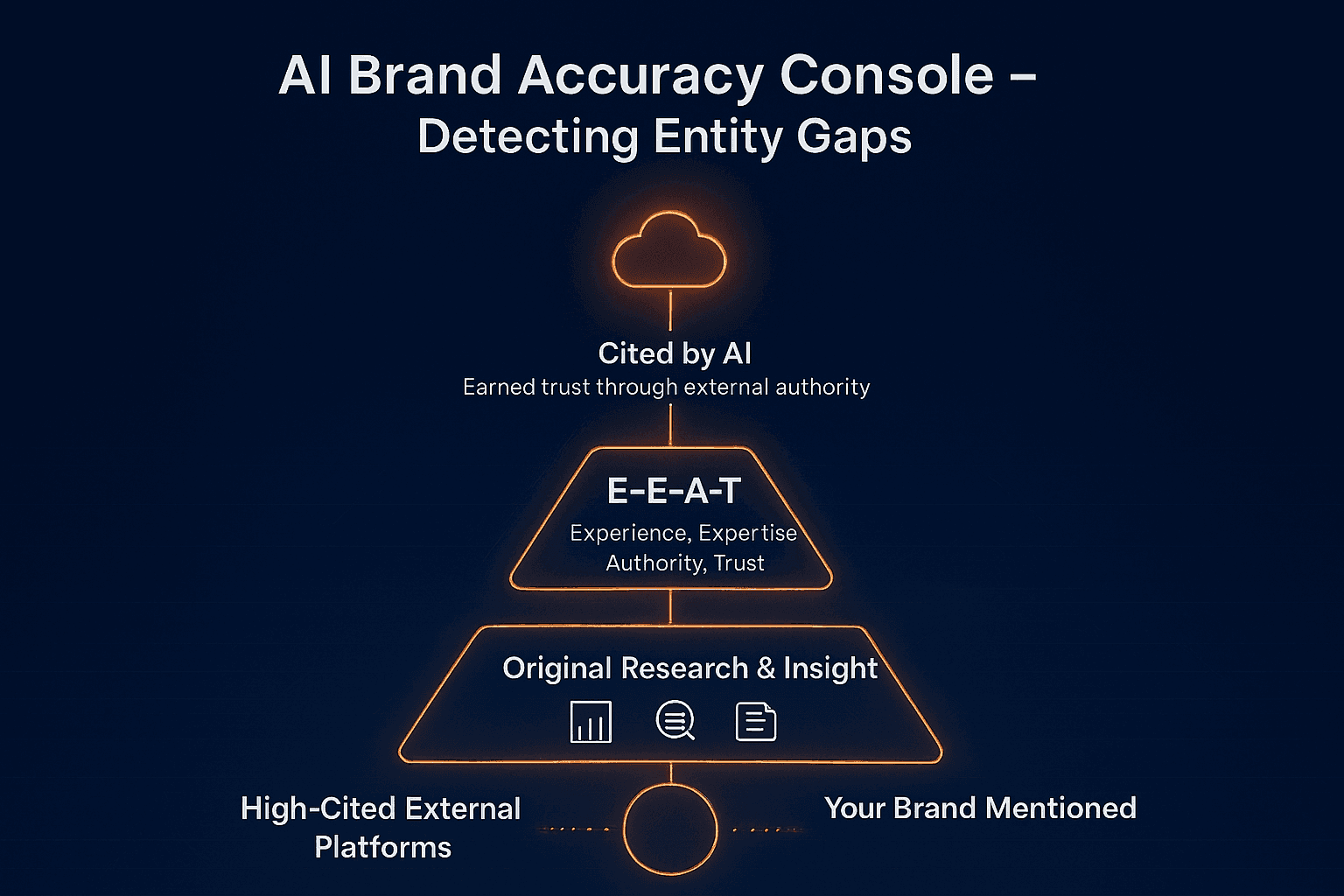
Once you've structured your content and data, your next job is to check the results. You need to see if the AI is picking up your brand language correctly, and if not, where the knowledge gaps are.
Actionable Tactic | Objective | Key Questions to Answer |
Consistent Query Sampling | Monitor the Share of Voice (SOV) for your brand over time in AI results. | How frequently does your brand name appear in the answers to your most common informational and commercial questions? |
Commercial Prompts vs. Knowledge Prompts | Check to see if the AI views you as a potential business venture or an authority in the field. | "What are the best CRM tools for B2B?" is the commercial question. Understanding: "What are the core features of [Your Product]?" |
Track Citation Domains | Determine which of your webpages and which external websites the LLM is genuinely citing. | How can you strengthen the authority and structure of your content on a given topic if a competitor's article is cited but yours isn't? |
Analyze "Entity Gaps" | Pinpoint topics or industry problems where your competitors are mentioned, but your brand is invisible to the AI. | For example, if you sell "Ransomware Protection," but the AI only mentions your competitor for that term, you have an entity gap to fill. |
Step 5: Refine the Model and Address Inconsistencies
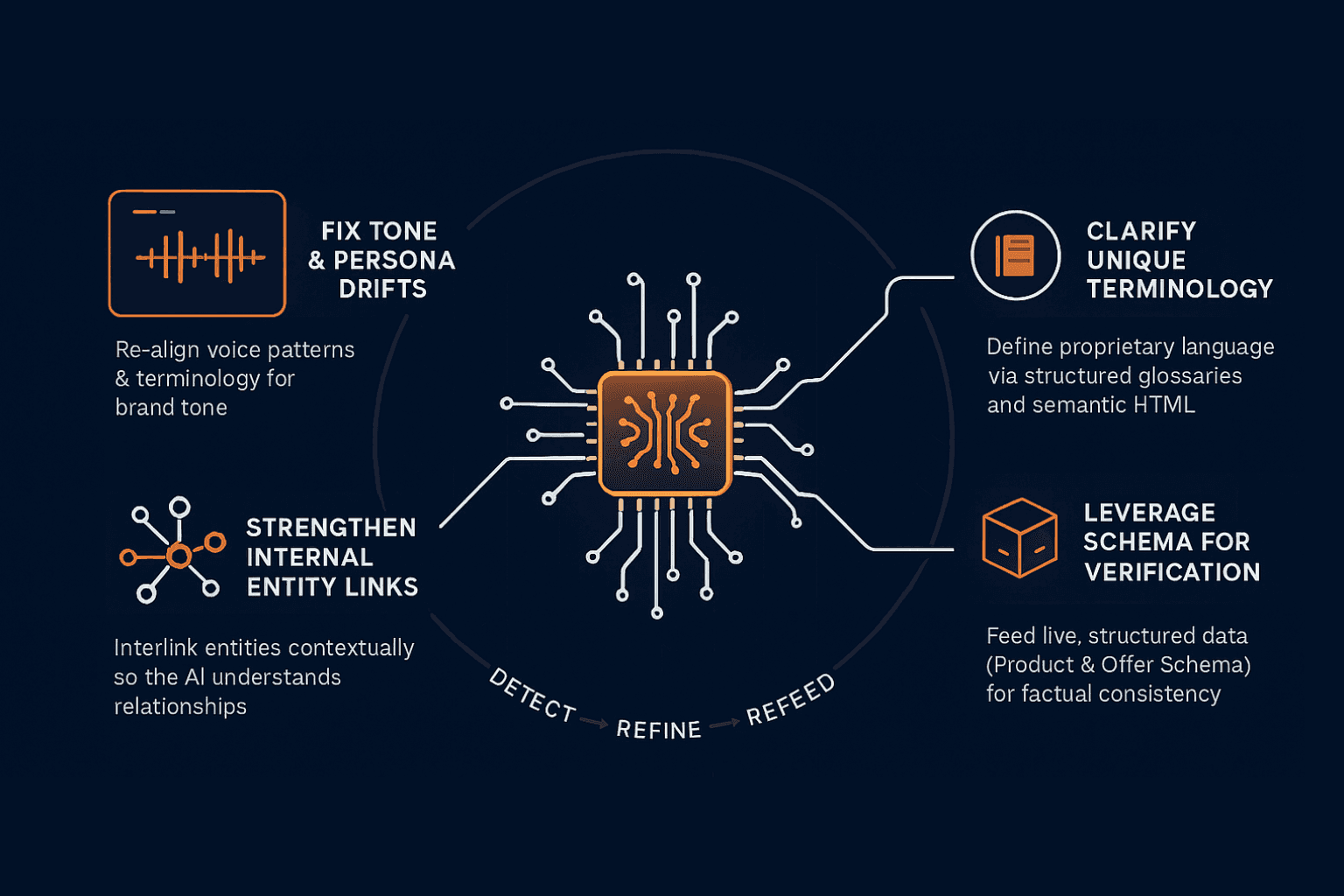
Monitoring will reveal where the AI "misunderstands" your brand. Use these insights to surgically adjust your content and reinforce your brand's distinct positioning.
Actionable Tactic | Why the LLM Might Be Confused | Refinement Strategy |
Fix Tone and Persona Drifts | The AI employs language that seems excessively formal, informal, or unsuitable for your brand (e.g., jargon misuse). | Combine your high-authority content and update your content style guide. Check that your ideal brand voice is consistently copied by your most authoritative pages. |
Clarify Unique Terminology | Your personal term (such as "FlowState Logic") is mentioned by the AI, but it is unable to define it. | Provide a brief, simple glossary section on your website. To define your custom language for the AI, use clear semantic HTML (such as definition lists). |
Strengthen Internal Entity Links | Although your primary product is mentioned, the AI makes no connection between it and the issue it resolves. | To link related entities together, use internal linking. To demonstrate to the AI the connections, each reference to your main product should lead to the appropriate use-case or solution page. |
Leverage Schema for Verification | The AI points to out-of-date product features or prices. | Check that your schema for products and offers is always up to date and correct. The AI frequently checks this structured data first for verified data like availability or price. |
Step 6: Future-Proof with Generative Strategy
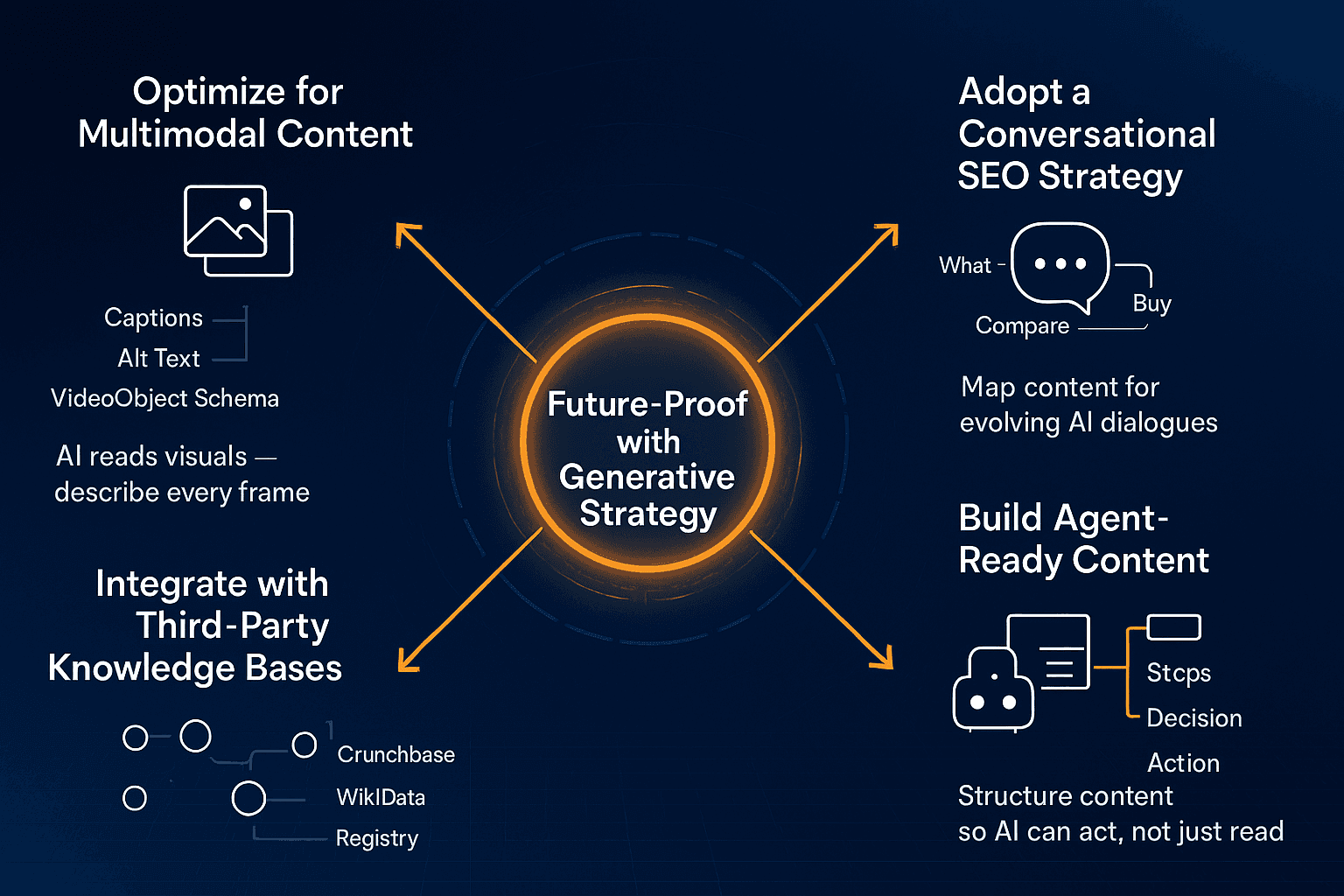
The AI landscape is constantly evolving, with new models and conversational features emerging. Future-proofing means designing your content to thrive in a conversational, multimodal, and agentic future.
Actionable Tactic | Why It Matters for the Future of AI | Focus Area |
Optimize for Multimodal Content | AI is progressing beyond text. It can combine data from videos and pictures. | Make sure that every image and video has alt-text, titles, and comprehensive, entity-rich captions. To properly describe video content, use the VideoObject schema. |
Adopt a Conversational SEO Strategy | Future AI agents will ask follow-up questions and plan in multiple steps. | Include questions like "What is X?" "How does X compare to Y?" and "What is the cheapest way to buy X?" in your content mapping to the full customer journey. |
Build Agent-Ready Content | AI "agents" will perform tasks for the user, such as filling out a form or scheduling a flight. | Provide content that is easy for an autonomous agent to understand and act upon by outlining decision points, steps, and transactional information in a clear, structured manner. |
Integrate with Third-Party Knowledge Bases | Certain AI platforms obtain factual information directly from particular data sources. | Keep your profile current and accurate on valuable public data sources, such as industry-specific registries or Crunchbase. |
Conclusion: Your Brand as an AI-Recognized Entity
Visibility in the age of generative AI is characterized by authority, structure, and clarity. Making sure that machines can consistently understand and trust your message requires a fundamental change in your content strategy, not a technical hack.
There are three strategic phases to the entire process:
Phase | Core Goal | Primary Action | Result for the Brand |
Phase I: Entity Foundation (Steps 1-3) | Make your brand a consistent, reliable, and verifiable identity in the global knowledge graph. | Secure high-authority citations on websites the AI trusts (such as Wikipedia, Reddit, and reliable publications) and use Schema Markup (Organization, Product, FAQ). | The AI is aware of your identity and the reasons it should believe you to be a reliable source. |
Phase II: Language Optimization (Step 2) | Organize your content so that the AI's synthesis layer can extract it quickly, accurately, and consistently. | Make tables, bulleted lists, and succinct Q&A sections. Include concise, uncomplicated definitions with your distinctive brand vocabulary on a regular basis. | The AI is aware of what to say about you and what to quote as a conclusive response. |
Phase III: Continuous Refinement (Steps 4-6) | Keep an eye on AI output, spot knowledge gaps, and prepare your presence for changing models in a strategic manner. | Track brand mentions, improve unclear terms, and optimize content for agentic and multimodal (image/video) consumption by frequently querying LLMs. | As generative search develops, your brand stays accurate, competitive, and visible. |